Multimedia Database |
|
| Innovative
new computer software makes it possible to manage, code,
and analyze large quantities of video data.
|
Constructing the
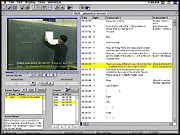
Multimedia Database Once the tapes were collected, they were sent to project headquarters at UCLA for transcription, coding, and analysis. The first step in this process was to digitize the video and store it in a multimedia database, together with scanned images of supplementary materials. Digital video offers several advantages over videotape for use in video studies. The resulting files are far more durable and long-lasting than videotape, and they will not wear out or degrade with repeated playing and re-playing of parts of the video, as happens during analysis. Digital video also enables random, instantaneous access to any location on the video, a feature that makes possible far more sophisticated analyses than are possible with videotape. The videotapes were then transcribed, and the transcripts were linked by time codes to the video. German and Japanese transcripts were translated into English. Transcription of videotapes is essential for coding and analysis. Without a transcript, coders have difficulty hearing, much less interpreting, the complex flow of events that stream past in a classroom lesson. Using multimedia database software system developed for this project, coders had instant access to the video as they worked with the linked transcript, making it easy to retrieve the context needed for interpreting the transcript. All event codes were marked, stored, and linked with a time code to the video, all within the same database. |
|
|
|
 |
|