The Kind of Mathematics that is Taught |
|
|
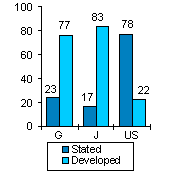
Average percentage
of topics in each |
The
Nature of Mathematics in the Lesson The nature of the content also differed across countries. For example, most mathematics lessons include some mixture of concepts, and applications of those concepts to solving problems. How concepts are presented, however, varies a great deal across countries. Concepts might simply be stated, as in "the Pythagorean Theorem states that a2 + b2 = c2," or they might be developed and derived over the course of the lesson. The graph shows the percentage of topics in each lesson that contained concepts that were developed vs. only stated. More than three-fourths of German and Japanese teachers developed concepts when they included them in their lessons, compared with less than one-fifth of US teachers. It is likely that the kind of mathematics that students learn is related to the nature of the mathematics that they are asked to study. Although constructing proofs and reasoning deductively are important aspects of mathematics, American students lacked opportunities to engage in these kinds of activities. None of the US lessons included proofs, whereas 10 percent of German lessons and 53 percent of Japanese lessons included proofs. In a separate analysis of 30 lessons from each country conducted by a group of experienced college mathematics teachers, 62 percent of Japanese lessons were found to include deductive reasoning, compared to 21 percent in Germany and zero percent in the US. |
 |
|
|
|
|