|
Mathematics Core Curriculum MST Standard 3 K -
Grade 12 Revised March 2005 PreK K 1 2 3 4 5 6 7 8
|
|
|
|
THE UNIVERSITY OF THE
STATE OF NEW YORK http://www.emsc.nysed.gov |
|
Mathematics Core Curriculum MST Standard 3 K -
Grade 12 Revised March 2005 PreK K 1 2 3 4 5 6 7 8
|
|
|
|
THE UNIVERSITY OF THE
STATE OF NEW YORK http://www.emsc.nysed.gov |
THE UNIVERSITY OF THE STATE OF NEW YORK
Regents of The University
Robert
M. Bennett, Chancellor, B.A., M.S.
Tonawanda
Adelaide
L. Sanford, Vice Chancellor, B.A., M.A., P.D.
Hollis
Diane
O’Neill McGivern, B.S.N., M.A., Ph.D. .
Staten
Island
Saul
B. Cohen, B.A., M.A., Ph.D.
New
Rochelle
James
C. Dawson, A.A., B.A., M.S., Ph.D.
Peru
Anthony
S. Bottar, B.A., J.D.
North
Syracuse
Merryl
H. Tisch, B.A., M.A.
New
York
Geraldine
D. Chapey, B.A., M.A., Ed.D.
Belle
Harbor
Arnold
B. Gardner, B.A., LL.B.
Buffalo
Harry
Phillips, 3rd, B.A., M.S.F.S.
Hartsdale
Joseph
E. Bowman, Jr., B.A., M.L.S., M.A., M.Ed., Ed.D
Albany
Lorraine
A. CortÉs-VÁzquez, B.A., M.P.A.
Bronx
James
R. Tallon, Jr., B.A., M.A.
Binghamton
Milton
L. Cofield, B.A., M.B.A., Ph.D.
Rochester
John
Brademas, B.A., Ph.D.
New
York
President of
The University
and Commissioner of Education
Richard P.
Mills
Chief of Staff
Counsel and
Deputy
Commissioner for Legal Affairs
Kathy A. Ahearn
Chief
Operating Officer
Deputy
Commissioner for
the Office of Management Services
Theresa E. Savo
Deputy
Commissioner for
Elementary, Middle, Secondary, and Continuing Education
James A.
Kadamus
Assistant
Commissioner for
Curriculum and Instructional Support
Jean C. Stevens
Assistant
Director for
Curriculum, Instruction, and Instructional Technology
Anne Schiano
The State
Education
Department does not discriminate on the basis of age, color, religion,
creed,
disability, marital status, veteran status, national origin, race,
gender,
genetic predisposition or carrier status, or sexual orientation in its
educational programs, services and activities. Portions of this
publication can
be made available in a variety of formats, including braille, large
print or
audio tape, upon request. Inquiries concerning this policy of
nondiscrimination
should be directed to the Department’s Office for Diversity, Ethics,
and
Access, Room 530, Education Building, Albany, New York 12234.
Acknowledgment
The State Education Department
acknowledges the following individuals who substantially contributed to
the
content of the revised Mathematics Core Curriculum.
|
Sherri Blais
Teacher of Mathematics
Monticello School District |
Carlos X. Leal
Elementary
Math Lead Teacher
Rochester School District |
|
Judith Blood
Elementary Teacher
Ithaca School District |
Jennifer Lorio
Elementary
Teacher
Yonkers School District |
|
James Boswell
Alternative Education Teacher
Capital Region BOCES |
Gwen McKinnon
Middle School
Principal
Syracuse School District |
|
William
Brosnan
Superintendent of Schools
Northport-East Northport School District |
Theresa
McSweeney
Teacher of
Mathematics
Marcellus School District |
|
Jacqueline
Bull
Coordinator
of Mathematics, K-8
Clarence School District |
Brenda Myers
Deputy
Superintendent
Broome-Tioga BOCES |
|
Melba Campbell
Teacher of
Mathematics
Samuel Gompers High School (NYC) |
Miguelina
Ortiz
Elementary
Teacher
Baldwin School District |
|
William
Caroscio
Teacher of
Mathematics
Elmira School District |
Alfred
Posamentier
Dean, School
of Education, City College
Professor of Mathematics |
|
Vincent Cullen
Certified
Public Accountant
Long Island |
Roderick
Sherman
Teacher of
Mathematics
Plattsburgh School District |
|
Andrew
Giordano
Construction
Engineer
Albany |
Susan
Solomonik
Math
coach/Teacher
IS 119 (NYC) |
|
Carolyn
Goldberg
Professor of
Mathematics
Niagara County Community College |
Debra Sykes
Director of
Mathematics
Buffalo School District |
|
Robert Gyles
Professor of
Mathematics Education
CUNY Hunter (NYC) |
Thomas Tucker
Professor of
Mathematics
Colgate University, Hamilton |
|
Daniel Jaye
Assistant
Principal/Math Teacher
Stuyvesant High School (NYC) |
Stephen West
Professor of
Mathematics
SUNY Geneseo |
Introduction
Every teacher of mathematics,
whether at the elementary,
middle, or high school level, has an individual goal to provide
students with
the knowledge and understanding of the mathematics necessary to
function in a
world very dependent upon the application of mathematics.
Instructionally, this goal translates
into three components:
v
conceptual understanding
v
procedural fluency
v
problem solving
Conceptual
understanding
consists of those relationships constructed internally and connected to
already
existing ideas. It involves the
understanding of mathematical ideas and procedures and includes the
knowledge
of basic arithmetic facts.
Students use conceptual understanding of mathematics when they
identify
and apply principles, know and apply facts and definitions, and compare
and
contrast related concepts. Knowledge
learned with understanding provides a foundation for remembering or
reconstructing mathematical facts and methods, for solving new and
unfamiliar
problems, and for generating new knowledge.
Procedural
fluency
is the skill
in carrying out procedures flexibly,
accurately, efficiently, and appropriately. It
includes, but is not limited to, algorithms (the
step-by-step routines needed to perform arithmetic operations). Although the word procedural may imply an arithmetic
procedure to
some, it also refers to being fluent with procedures from other
branches of
mathematics, such as measuring the size of an angle using a protractor. The use of calculators need not
threaten the development of students’ computational skills. On the contrary, calculators can enhance
both understanding and computing if used properly and effectively. Accuracy and efficiency with procedures
are important, but they should be developed through understanding. When students learn procedures through
understanding, they are more likely to remember the procedures and less
likely
to make common computational errors.
Problem
solving is
the
ability to formulate, represent, and solve mathematical problems. Problems generally fall into three
types:
v
one-step problems
v
multi-step problems
v
process problems
Most
problems
that students will encounter in the real world are multi-step or
process
problems. Solution of these
problems involves the integration of conceptual understanding and
procedural
knowledge. Students need to have a
broad range of strategies upon which to draw. Selection
of a strategy for finding the solution to a
problem is often the most difficult part of the solution.
Therefore, mathematics instruction must
include the teaching of many strategies to empower all students to
become
successful problem solvers.
A concept or procedure in itself is not useful in problem
solving unless
one recognizes when and where to use it as well as when and where it
does not
apply. Many textbook problems are
not typical of those that students will meet in real life.
Therefore, students need to be able to
have a general understanding of how to analyze a problem and how to
choose the
most useful strategy for solving the problem.
Individually,
each of these components (conceptual understanding, procedural fluency,
and
problem solving) is necessary but not sufficient for a student to be
mathematically proficient. They are not, however, independent of each
other. They are integrally
related, need to be taught simultaneously, and should be a component of
every
lesson.
The
mathematics standard presented in this document states that students
will:
v
understand the concepts of and
become
proficient with the skills of mathematics;
v
communicate and reason
mathematically;
v
become problem solvers by
using appropriate
tools and strategies;
through
the
integrated study of number sense and operations, algebra, geometry,
measurement, and statistics and probability. Mathematics
should be viewed as a whole body of knowledge,
not as a set of individual components.
Therefore, local mathematics curriculum, instruction, and
assessment
should be designed to support and sustain the components of this
standard.
New
York State’s yearly 3-8 mathematics assessments, as required by NCLB
federal
legislation, will provide data measuring student progress toward
obtaining
mathematical proficiency. Since
the state assessments will measure conceptual understanding, procedural
fluency, and problem solving, local assessments should measure these
components
as well. Thus, many schools may
need to provide teachers with significant professional staff
development to
assist them in developing local assessments.
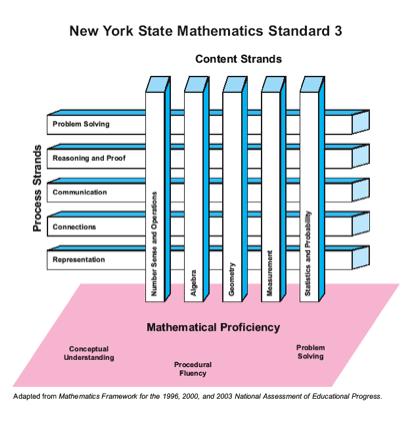
In
this document conceptual understanding, procedural fluency, and problem
solving
are represented as process strands and
content strands. These strands help to define what
students should know and be able to do as a result of their engagement
in the
study of mathematics.
Process
Strands: The
process
strands (Problem Solving, Reasoning and Proof, Communication,
Connections, and
Representation) highlight ways of acquiring and using content knowledge. These process strands help to give
meaning to mathematics and help students to see mathematics as a
discipline
rather than a set of isolated skills.
Student engagement in mathematical content is accomplished
through these
process strands. Students will
gain a better understanding of mathematics and have longer retention of
mathematical knowledge as they solve problems, reason mathematically,
prove
mathematical relationships, participate in mathematical discourse, make
mathematical connections, and model and represent mathematical ideas in
a
variety of ways.
Content
Strands: The
content
strands (Number Sense and Operations, Algebra, Geometry, Measurement,
and
Statistics and Probability) explicitly describe the content that
students
should learn. Each school’s mathematics curriculum developed from these
strands
should include a broad range of content.
This broad range of content, taught in an integrated fashion,
allows
students to see how various mathematics knowledge is related, not only
within
mathematics, but also to other disciplines and the real world as well. The performance indicators listed under
each band within a strand are intended to assist teachers in
determining what
the outcomes of instruction should be.
The instruction should engage students in the construction of
this
knowledge and should integrate conceptual understanding and problem
solving
with these performance indicators.
The performance indicators should not be viewed as a checklist
of skills
void of understanding and application.
Students
will only become successful in mathematics if they see mathematics as a
whole,
not as isolated skills and facts.
As school districts develop their own mathematics curriculum
based upon
the statements in this standards document, attention must be given to
both
content and process strands.
Likewise, as teachers develop their instructional plans and
their
assessment techniques, they also must give attention to the integration
of
process and content. To do
otherwise would produce students who have temporary knowledge and who
are
unable to apply mathematics in realistic settings.
Curriculum, instruction, and assessment are intricately
related and must be designed with this in mind. All
three domains must address conceptual understanding,
procedural fluency, and problem solving.
If this is accomplished, school districts will produce students
who will
(1) have mathematical knowledge, (2) have an understanding of
mathematical
concepts, and (3) be able to apply mathematics in the solution of
problems.
School
districts and individual teachers should be aware that this document is
a
standards document that guides the development of local curriculum. Local school districts remain
responsible for developing curriculum aligned to the New York State
standards. In this document the
mathematics standard is succinctly stated. The
standard outlines what students should know and be able
to do in mathematics. The content
strands, consisting of bands and performance indicators within each
band, and
the performance indicators of the process strands help to define how
the
standard will be met. Each school
district’s mathematics curriculum should be developed to assure that
all
students achieve the performance indicators for both the process and
content
strands.
Helping
all students become proficient in mathematics is an imperative goal for
every
school. It is the hope that this
standards document will assist schools and individual teachers in
meeting this
goal. For additional information
visit the New York State Education Department mathematics website http://www.emsc.nysed.gov/ciai/mst/math.html
.
Students
will:
•understand the concepts of
and become
proficient with the skills of mathematics;
•communicate and reason
mathematically;
•become problem solvers by
using
appropriate tools and strategies;
through
the
integrated study of number sense and operations, algebra, geometry,
measurement, and statistics and probability.
Students
will:
•understand
numbers, multiple ways of representing numbers, relationships
among
numbers, and number systems;
•understand
meanings of operations and procedures, and how they relate to one
another;
•compute accurately and make
reasonable
estimates.
Algebra
Strand
Students
will:
•represent and analyze
algebraically a
wide variety of problem solving situations;
•perform algebraic procedures
accurately;
•recognize, use, and represent
algebraically patterns, relations, and functions.
Geometry
Strand
Students
will:
•use
visualization and spatial reasoning to analyze characteristics and
properties
of
geometric shapes;
•identify and justify
geometric
relationships, formally and informally;
•apply transformations and
symmetry to
analyze problem solving situations;
•apply coordinate geometry to
analyze
problem solving situations.
Measurement
Strand
Students
will:
•determine
what can be measured and how, using appropriate methods and
formulas;
•use units to give meaning to
measurements;
•understand
that all measurement contains error and be able to determine its
significance;
•develop strategies for
estimating measurements.
Students
will:
•collect, organize, display,
and analyze
data;
•make predictions that are
based upon
data analysis;
•understand and apply concepts
of
probability.
Students
will:
•build
new
mathematical knowledge through problem solving;
•solve problems that arise in
mathematics
and in other contexts;
•apply
and adapt
a variety of appropriate strategies to solve problems;
•monitor
and
reflect on the process of mathematical problem solving.
Students
will:
•recognize
reasoning and proof as fundamental aspects of mathematics;
•make
and
investigate mathematical conjectures;
•develop
and
evaluate mathematical arguments and proofs;
•select
and use
various types of reasoning and methods of proof.
Students
will:
•organize and consolidate their mathematical thinking through communication;
•communicate
their mathematical thinking coherently and clearly to peers,
teachers,
and others;
•analyze
and evaluate the mathematical thinking and strategies of others;
•use
the
language of mathematics to express mathematical ideas precisely.
Students
will:
•recognize and use connections
among
mathematical ideas;
•understand
how mathematical ideas interconnect and build on one another to
produce
a coherent whole;
•recognize
and
apply mathematics in contexts outside of mathematics.
Students
will:
•create
and use representations to organize, record, and communicate
mathematical
ideas;
•select,
apply, and translate among mathematical representations to solve
problems;
•use
representations to model and interpret physical, social, and
mathematical
phenomena.
Bands
Within the Content Strands
•Number
Systems
•
Number
Theory
•
Operations
•
Estimation
•
Variables
and Expressions
•
Equations
and Inequalities
•
Patterns,
Relations, and Functions
•
Coordinate
Geometry
•
Trigonometric
Functions
•Shapes
•Geometric
Relationships
•Transformational
Geometry
•Coordinate
Geometry
•Constructions
•Locus
•Informal
Proofs
•Formal
Proofs
•Units
of Measurement
•Tools
and Methods
•Units
•
Error
and Magnitude
•Estimation
•Collection
of Data
•
Organization
and Display of Data
•
Analysis
of Data
•
Predictions
from Data
•Probability
|
Students
will build new mathematical knowledge through problem solving.
PK.PS.1 Explore, examine, and make
observations
about a social problem
or mathematical
situation
PK.PS.2 Interpret information
correctly,
identify the problem, and
generate possible
solutions
Students
will solve problems that arise in mathematics and in other contexts.
PK.PS.3 Act out or model with manipulatives activities
involving
mathematical content from
literature and/or story telling
PK.PS.4 Formulate problems and
solutions from
everyday situations
(e.g., as counting the
number of
children in the class or using the
calendar to teach counting)
Students
will apply and adapt a variety of appropriate strategies to solve
problems.
PK.PS.5 Use informal counting
strategies
to find solutions
PK.PS.6 Experience
teacher-directed
questioning process to understand
problems
PK.PS.7 Compare and discuss
ideas for
solving a problem with teacher
and/or students
to
justify their thinking
PK.PS.8 Use manipulatives
(e.g., tiles,
blocks) to model the action in
problems
PK.PS.9 Use
drawings/pictures to
model the action in problems
Students
will monitor and reflect on the process of mathematical problem solving.
PK.PS.10 Explain to others how a
problem was
solved, giving strategies
PK.RP.1 Understand that
mathematical
statements can be true or false
Students
will make and investigate mathematical conjectures.
PK.RP.2 Investigate the use of
knowledgeable guessing as a mathematical
tool
PK.RP.3 Explore guesses, using
a variety
of objects and manipulatives
Students
will develop and evaluate mathematical arguments and proofs.
PK.RP.4 Listen to claims other
students
make
Students
will organize and consolidate their mathematical thinking through
communication.
PK.CM.1 Understand how to
organize their
thought processes with
teacher guidance
Students
will communicate their mathematical thinking coherently and clearly to
peers,
teachers,
and others.
PK.CM.2 Share
mathematical ideas through the
manipulation of objects,
drawings, pictures, and verbal
explanations
Students
will analyze and evaluate the mathematical thinking and strategies of
others.
PK.CM.3 Listen to solutions shared by other students
PK.CM.4 Formulate
mathematically relevant questions with
teacher
guidance
Students
will use the language of mathematics to express mathematical ideas
precisely.
PK.CM.5 Use appropriate mathematical terms, vocabulary, and language
Students
will recognize and apply mathematics in contexts outside of mathematics.
PK.CN.1 Recognize
the presence of mathematics
in their daily lives
PK.CN.2 Use
counting strategies to solve
problems in their daily lives
PK.CN.3 Recognize
and apply mathematics to
objects and pictures
Students
will create and use representations to organize, record, and
communicate
mathematical
ideas.
PK.R.1 Use multiple representations, including verbal language, acting
out or modeling a situation, and drawing pictures as
representations
PK.R.2 Use standard and nonstandard representations
Students will
use
representations to model and interpret physical, social, and
mathematical
phenomena.
PK.R.3 Use objects to show and understand physical phenomena
(e.g., guess the number of cookies in a package)
PK.R.4 Use objects to show and understand social phenomena
(e.g., count and represent sharing cookies between friends)
PK.R.5
Use objects to show and understand
mathematical phenomena
(e.g., draw pictures to
show a story problem, show number
value using fingers on your hand)
Students
will understand numbers, multiple ways of representing numbers,
relationships
among
numbers, and number systems.
Number Systems PK.N.1 Count the items in a collection and know the last counting word
tells
how many items are in the collection (1 to 10)
PK.N.2 Count
out (produce) a collection of a specified size 1 to 10
PK.N.3 Verbally
count by 1’s to 10
PK.N.4 Explore
the different representations of a group of objects
PK.N.5 Draw
pictures or other informal symbols
to represent a spoken
number up to 5
PK.N.6 Draw
pictures or other informal symbols to represent how
many
in a collection up to 5
PK.N.7 Recognize
numerals (0-5)
PK.N.8 Use
and understand the terms first and last
Students
will understand
meanings of operations and procedures, and how they relate to one
another.
and subtraction involving one to
four
items, using manipulatives
Students
will recognize,
use, and represent algebraically patterns, relations, and functions.
Patterns,
Relations, PK.A.1 Duplicate
simple patterns using concrete objects
Students
will use
visualization and spatial reasoning to analyze characteristics and
properties
of geometric shapes.
PK.G.2 Informally play with solids
(e.g.,
building blocks)
Students
will determine what can be measured and how, using appropriate methods
and
formulas.
Units of
PK.M.1
Develop language such as bigger,
longer, and taller to discuss
Measurement
length
PK.M.2 Relate specific times
such as day
and night
Students
will collect,
organize, display, and analyze data.
Organization
and PK.S.1 Sort
and organize objects by one attribute (e.g., color,
size, or Display of Data
shape)
PK.S.2 Use physical objects to make
graphs
Analysis
of
Data
PK.S.3
Count and compare groups formed (quantify groups formed)
PK.S.4 Describe the attributes of
objects
Kindergarten
Students
will build new mathematical knowledge through problem solving.
K.PS.1 Explore, examine, and make
observations
about a social problem
or mathematical situation
K.PS.2 Interpret information
correctly,
identify the problem, and
generate possible solutions
Students
will solve problems that arise in mathematics and in other contexts.
K.PS.3 Act out or model with manipulatives activities
involving
mathematical content from literature
and/or story telling
K.PS.4 Formulate problems and
solutions from
everyday situations
(e.g., counting the number of
children
in the class, using the
calendar to teach counting).
Students
will apply and adapt a variety of appropriate strategies to solve
problems.
K.PS.5 Use informal counting
strategies to
find solutions
K.PS.6 Experience teacher-directed
questioning
process to understand
problems
K.PS.7 Compare and discuss ideas
for solving a
problem with teacher
and/or students to justify their
thinking
K.PS.8 Use manipulatives (e.g.,
tiles, blocks)
to model the action in
problems
K.PS.9 Use drawings/pictures to
model the
action in problems
Students
will monitor and reflect on the process of mathematical problem solving.
K.PS.10
Explain to others how a problem was solved, giving strategies
K.RP.1 Understand that
mathematical
statements can be true or false
Students
will make and investigate mathematical conjectures.
K.RP.2 Investigate the use of
knowledgeable guessing as a mathematical
tool
K.RP.3 Explore guesses, using
a variety
of objects and manipulatives
Students
will develop and evaluate mathematical arguments and proofs.
K.RP.4 Listen to claims other
students
make
Students
will organize and consolidate their mathematical thinking through
communication.
K.CM.1 Understand how to
organize their
thought processes with
teacher
guidance
Students
will communicate their mathematical thinking coherently and clearly to
peers,
teachers,
and others.
K.CM.2
Share mathematical ideas through the manipulation of objects,
drawings, pictures, and verbal explanations
Students
will analyze and evaluate the mathematical thinking and strategies of
others.
K.CM.3 Listen to solutions shared by other students
K.CM.4 Formulate
mathematically relevant
questions with teacher
guidance
Students
will use the language of mathematics to express mathematical ideas
precisely.
K.CM.5 Use appropriate mathematical terms, vocabulary, and language
Students
will recognize and apply mathematics in contexts outside of mathematics.
K.CN.1 Recognize the presence
of mathematics in their daily lives
K.CN.2 Use counting
strategies to solve problems in their daily lives
K.CN.3 Recognize and apply
mathematics to objects and pictures
Students
will create and use representations to organize, record, and
communicate
mathematical
ideas.
K.R.1 Use multiple representations, including verbal language, acting
out or modeling a situation, and drawing pictures as
representations
K.R.2 Use standard and nonstandard representations
Students will
use
representations to model and interpret physical, social, and
mathematical
phenomena.
K.R.3 Use objects to show and understand physical phenomena
(e.g., guess the number of cookies in a package)
K.R.4 Use objects to show and understand social phenomena
(e.g., count and represent sharing cookies between friends)
K.R.5
Use objects to show and understand mathematical phenomena
(e.g., draw pictures to
show a story problem, show number
value using fingers on your hand)
Students will
understand
numbers, multiple ways of representing numbers, relationships among
numbers,
and number systems.
Number Systems K.N.1 Count the items in a collection and know the last counting word
tells how many items are in the collection (1 to 10)
K.N.2 Count
out (produce) a collection of a specified size 1 to 10
K.N.3 Numerically
label a data set of 1 to 5
K.N.4
Verbally count by 1’s to 20
K.N.5 Verbally
count backwards from 10
K.N.6 Represent
collections with a finger pattern up to 10
K.N.7 Draw
pictures or other informal symbols to represent a spoken number up to 10
K.N.8 Draw
pictures or other informal symbols to represent how many in
a
collection up to 10
K.N.9 Write
numbers 1-10 to represent a collection
K.N.10
Visually determine how many more or less, and then using the
verbal
counting sequence, match and
count 1-10
K.N.11 Use and understand
verbal ordinal
terms, first to tenth
Students will
understand
meanings of operations and procedures, and how they relate to one
another.
K.N.13 Determine sums and differences by various means
Students will
recognize,
use, and represent algebraically patterns, relations, and functions.
Patterns,
Relations, K.A.1 Use
a variety of manipulatives to create patterns using
attributes of and Functions
color,
size, or shape
K.A.2 Recognize,
describe, extend, and create patterns that repeat
(e.g.,
ABABAB or ABAABAAAB)
Students
will use visualization and spatial reasoning to analyze characteristics
and
properties
of
geometric shapes.
Shapes
K.G.1 Describe
characteristics and relationships of geometric objects
Students will
identify and
justify geometric relationships, formally and informally.
Geometric
K.G.2 Sort groups of objects by size and size order
(increasing
and Relationships
decreasing)
Students will
apply
transformations and symmetry to analyze problem solving situations.
Transformational K.G.3 Explore
vertical and horizontal orientation of objects
K.G.4 Manipulate two- and three-dimensional shapes
to explore
symmetry
Students will
apply
coordinate geometry to analyze problem solving situations.
Coordinate
K.G.5 Understand and use ideas such as over, under,
above, below,
on, Geometry
beside,
next to, and between
Students will
determine
what can be measured and how, using appropriate methods and formulas.
Units of
K.M.1
Name, discuss, and compare
attributes of length (longer than,
Measurement
shorter
than)
K.M.2
Compare the length of two objects by representing each length with
string or a paper strip
K.M.3 Relate
specific times such as morning, noon, afternoon, and evening to
activities and
absence or presence of daylight
Students
will collect, organize, display, and analyze data.
Organization
and K.S.2 Help to make simple
pictographs for quantities up to 10, where one Display of Data
picture
represents 1
K.S.3 Sort
and organize objects by two attributes (e.g., color, size, or shape)
K.S.4
Represent data using manipulatives
Analysis
of
Data
K.S.5 Identify more, less, and same amounts from
pictographs or
concrete
models
Grade 1
Students
will build new mathematical knowledge through problem solving.
1.PS.1 Explore, examine, and make
observations
about a social problem
or mathematical situation
1.PS.2 Interpret information
correctly,
identify the problem, and
generate possible solutions
Students
will solve problems that arise in mathematics and in other contexts.
1.PS.3 Act out or model with manipulatives activities
involving
mathematical content from literature
and/or story telling
1.PS.4 Formulate problems and
solutions from
everyday situations
(e.g.,
counting the number of children in the class or using the
calendar
to teach counting)
Students
will apply and adapt a variety of appropriate strategies to solve
problems.
1.PS.5 Use informal counting
strategies
to find solutions
1.PS.6 Experience
teacher-directed
questioning process to understand
problems
1.PS.7 Compare and discuss
ideas for
solving a problem with teacher
and/or students to justify their
thinking
1.PS.8 Use manipulatives
(e.g., tiles,
blocks) to model the action in
problems
1.PS.9 Use drawings/pictures
to model
the action in problems
Students
will monitor and reflect on the process of mathematical problem solving.
1.PS.10
Explain to others how a problem was solved, giving strategies
and justifications
1.RP.1 Understand
that mathematical statements can be true or false
1.RP.2 Recognize
that mathematical ideas need to be supported by
evidence
Students
will make and investigate mathematical conjectures.
1.RP.3 Investigate
the use of knowledgeable guessing as a
mathematical
tool
1.RP.4 Explore
guesses, using a variety of objects and
manipulatives
Students
will develop and evaluate mathematical arguments and proofs.
1.RP.5
Justify general claims, using manipulatives
1.RP.6
Develop and explain an argument verbally or with objects
1.RP.7
Listen to and discuss claims other students make
Students
will select and use various types of reasoning and methods of proof.
1.RP.8 Use
trial and error strategies to verify claims
Students
will organize and consolidate their mathematical thinking through
communication.
1.CM.1 Understand how to
organize their
thought processes with
teacher
guidance
1.CM.2
Verbally support their reasoning and answer
Students
will communicate their mathematical thinking coherently and clearly to
peers,
teachers,
and others.
1.CM.3
Share mathematical ideas through the manipulation of objects,
drawings, pictures, charts,
and symbols
in both written and verbal
explanations
Students
will analyze and evaluate the mathematical thinking and strategies of
others.
1.CM.4 Listen to solutions shared by other students
1.CM.5
Formulate mathematically relevant questions
Students
will use the language of mathematics to express mathematical ideas
precisely.
1.CM.6 Use appropriate mathematical terms, vocabulary, and language
Students
will recognize and use connections among mathematical ideas.
1.CN.1
Recognize the connections of patterns in their everyday
experiences
to mathematical ideas
1.CN.2
Understand the connections between numbers and the quantities
they
represent
1.CN.3
Compare the similarities and differences of mathematical ideas
Students
will understand how mathematical ideas interconnect and build on one
another to
produce
a
coherent whole.
1.CN.4 Understand how models
of situations involving objects, pictures,
and
symbols relate to mathematical ideas
1.CN.5
Understand meanings of operations and how they relate to one
another
1.CN.6
Understand how mathematical models represent quantitative
relationships
Students
will recognize and apply mathematics in contexts outside of mathematics.
1.CN.7
Recognize the presence of mathematics in their daily lives
1.CN.8
Recognize and apply mathematics to solve problems
1.CN.9
Recognize and apply mathematics to objects, pictures, and
symbols
Students
will create and use representations to organize, record, and
communicate
mathematical
ideas.
1.R.1 Use multiple representations including verbal and written language,
acting out or modeling a situation, drawings, and/or symbols as
representations
1.R.2 Share mental images of mathematical ideas and understandings
1.R.3 Use standard and nonstandard representations
Students
will select, apply, and translate among mathematical representations to
solve
problems.
1.R.4 Connect mathematical representations with problem solving
Students will
use
representations to model and interpret physical, social, and
mathematical
phenomena.
1.R.5 Use mathematics to show and understand physical phenomena
(e.g., estimate and represent the number of apples in a tree)
1.R.6 Use mathematics to show and understand social phenomena
(e.g., count and represent sharing cookies between friends)
1.R.7 Use mathematics to show and understand mathematical
phenomena (e.g., draw pictures to show a story problem, show
number value using fingers on your hand)
Students will
understand
numbers, multiple ways of representing numbers, relationships among
numbers,
and number systems.
Number
Systems 1.N.1 Count
the items in a collection and know the last counting
word
tells how many items are in
the
collection (1 to 100)
1.N.2
Count
out (produce) a collection of a specified size (10 to 100 items), using
groups
of ten
1.N.3
Quickly
see and label with a number,
collections of 1 to 10
1.N.4
Count
by 1’s to 100
1.N.5
Skip
count by 10’s to 100
1.N.6 Skip
count by 5’s to 50
1.N.7 Skip
count by 2’s to 20
1.N.8 Verbally
count from a number other than one by 1’s
1.N.9 Count
backwards from 20 by 1’s
1.N.10 Draw
pictures or other informal symbols to represent a spoken number up to
20
1.N.11
Identify that
spacing of
the same number of objects does not affect
the quantity (conservation)
1.N.12 Arrange objects in size
order
(increasing and decreasing)
1.N.13 Write
numbers to 100
1.N.14 Read the number words one,
two,
three…ten
1.N.15 Explore and use place
value
1.N.16 Compare and order whole
numbers up
to 100
1.N.17
Develop an initial understanding of the base ten system:
10 ones = 1 ten
10 tens = 1 hundred
1.N.18 Use a variety of
strategies to
compose and decompose one-digit
numbers
1.N.19 Understand the
commutative
property of addition
1.N.20
Name the number before and the number after a given number, and
name
the number(s) between two given numbers up to 100 (with and without the
use of
a number line or a hundreds chart)
1.N.21
Use before, after, or between to order numbers to 100 (with or
without the use of a number
line)
1.N.22
Use the words higher, lower, greater, and less to compare two
numbers
1.N.23 Use and understand
verbal ordinal
terms, first to twentieth
Students will
understand
meanings of operations and procedures, and how they relate to one
another.
1.N.25
Represent addition and subtraction word problems and their
solutions as number sentences
1.N.26 Create
problem situations that represent a given number sentence
1.N.27 Use
a variety of strategies to solve addition and subtraction problems with
one-
and two-digit numbers without regrouping
1.N.28 Demonstrate
fluency and apply addition and subtraction facts to and including 10
1.N.29 Understand
that different parts can be added to get the same whole
Students
will compute accurately and make reasonable estimates.
Estimation
1.N.30 Estimate
the number in a collection to 50 and then compare by
counting the actual items in
the
collection
Students will
recognize,
use, and represent algebraically patterns, relations, and functions.
Patterns,
Relations, 1.A.1
Determine
and discuss patterns in arithmetic (what comes next in a and
Functions
repeating
pattern, using numbers or
objects)
Students
will use visualization and spatial reasoning to analyze characteristics
and
properties
of
geometric shapes.
1.G.2 Recognize,
name, describe, create, sort, and compare two-dimensional and
three-dimensional
shapes
Students will
apply
transformations and symmetry to analyze problem solving situations.
Transformational 1.G.3 Experiment
with slides, flips, and turns of two-dimensional shapes
Geometry
1.G.4
Identify symmetry in
two-dimensional shapes
Students will
apply
coordinate geometry to analyze problem solving situations.
Coordinate
1.G.5 Recognize
geometric shapes and structures in the environment
Students will
determine
what can be measured and how, using appropriate methods and formulas.
Units
of
1.M.1 Recognize
length as an attribute that can be measured
Measurement
1.M.2 Use
non-standard units (including finger lengths, paper clips, students’
feet and
paces) to measure both vertical and horizontal lengths
1.M.3 Informally
explore the standard unit of measure, inch
Students will
use units to
give meaning to measurements.
Units
1.M.4
Know vocabulary and recognize coins (penny,
nickel, dime,
quarter)
1.M.5 Recognize the cent notation as
¢
1.M.6 Use
different combinations of coins to make money amounts up to 25 cents
1.M.7 Recognize
specific times (morning, noon, afternoon, evening)
1.M.8 Tell
time to the hour, using both digital and analog clocks
1.M.9
Know the days of the week and months of the year in
sequence
1.M.10 Classify months and
connect to
seasons and other events
Students will
develop
strategies for estimating measurements.
Estimation
1.M.11
Select and use non-standard units to estimate measurements
Students
will collect, organize, display, and analyze data.
1.S.2
Collect and record data
related to a question
Organization
and 1.S.3
Display
data in simple pictographs for quantities up to 20 with Display of
Data
units
of one
1.S.4
Display data in bar graphs
using concrete objects with intervals of
one
1.S.5
Use Venn diagrams to sort and
describe data
Analysis
of
Data
1.S.6 Interpret
data in terms of the words: most, least, greater than, less
than, or equal to
1.S.7
Answer
simple questions related to data displayed in pictographs (e.g.,
category with
most, how many more in a category compared to another, how many all
together in
two categories)
Students will make predictions that are based upon data analysis.
Predictions from 1.S.8
Discuss
conclusions and make predictions in terms of the words Data
likely
and unlikely
1.S.9
Construct
a question that can be answered by using information from a graph
Grade 2
Students
will build new mathematical knowledge through problem solving.
2.PS.1 Explore, examine, and make
observations
about a social problem
or mathematical situation
2.PS.2 Interpret information
correctly,
identify the problem, and
generate possible solutions
Students
will solve problems that arise in mathematics and in other contexts.
2.PS.3 Act out or model with manipulatives activities
involving
mathematical content from literature
and/or story telling
2.PS.4 Formulate problems and
solutions from
everyday situations
(e.g., counting the number of
children
in the class, using the
calendar to teach counting).
Students
will apply and adapt a variety of appropriate strategies to solve
problems.
2.PS.5 Use informal counting
strategies
to find solutions
2.PS.6 Experience
teacher-directed questioning
process to understand
problems
2.PS.7 Compare and discuss
ideas for
solving a problem with teacher
and/or students to justify their
thinking
2.PS.8 Use manipulatives
(e.g., tiles,
blocks) to model the action in
problems
2.PS.9 Use drawings/pictures
to model
the action in problems
Students
will monitor and reflect on the process of mathematical problem solving.
2.PS.10
Explain to others how a problem was solved, giving strategies
and justifications
2.RP.1 Understand that
mathematical
statements can be true or false
2.RP.2 Recognize that
mathematical ideas
need to be supported by
evidence
Students
will make and investigate mathematical conjectures.
2.RP.3 Investigate the use of
knowledgeable guessing as a mathematical
tool
2.RP.4 Explore guesses, using
a variety
of objects and manipulatives
Students
will develop and evaluate mathematical arguments and proofs.
2.RP.5
Justify general claims, using manipulatives
2.RP.6
Develop and explain an argument verbally or with objects
2.RP.7
Listen to and discuss claims other students make
Students will select and use various
types of reasoning and methods of proof.
2.RP.8 Use
trial and error strategies to verify claims
Students
will organize and consolidate their mathematical thinking through
communication.
2.CM.1 Understand
how to organize their
thought processes
2.CM.2 Verbally
support their reasoning and
answer
Students
will communicate their mathematical thinking coherently and clearly to
peers,
teachers,
and others.
2.CM.3 Share
mathematical ideas through the
manipulation of objects,
drawings,
pictures, charts, and symbols
in both written and verbal
explanations
Students
will analyze and evaluate the mathematical thinking and strategies of
others.
2.CM.4 Listen to solutions shared by other students
2.CM.5 Formulate
mathematically relevant
questions
Students
will use the language of mathematics to express mathematical ideas
precisely.
2.CM.6 Use appropriate mathematical terms, vocabulary, and language
Students
will recognize and use connections among mathematical ideas.
2.CN.1 Recognize
the connections of patterns in their everyday
experiences
to mathematical ideas
2.CN.2 Understand
and use the connections between numbers and the
quantities
they represent to solve problems
2.CN.3
Compare the similarities and differences of mathematical ideas
Students
will understand how mathematical ideas interconnect and build on one
another to
produce
a
coherent whole.
2.CN.4 Understand how models
of situations involving objects, pictures,
and
symbols relate to mathematical ideas
2.CN.5
Understand meanings of operations and how they relate to one
another
2.CN.6
Understand how mathematical models represent quantitative
relationships
Students
will recognize and apply mathematics in contexts outside of mathematics.
2.CN.7
Recognize the presence of
mathematics
in their daily lives
2.CN.8
Recognize and apply mathematics to
solve problems
2.CN.9
Recognize and apply mathematics to
objects, pictures and
Students
will create and use representations to organize, record, and
communicate
mathematical
ideas.
2.R.1 Use multiple representations, including verbal and written
language, acting out or modeling a situation, drawings, and/or
symbols as representations
2.R.2 Share mental images of mathematical ideas and understandings
2.R.3 Use standard and nonstandard representations
Students
will select, apply, and translate among mathematical representations to
solve
problems.
2.R.4 Connect mathematical representations with problem solving
Students will
use
representations to model and interpret physical, social, and
mathematical
phenomena.
2.R.5 Use mathematics to show and understand physical phenomena
(e.g., estimate and represent the number of apples in a tree)
2.R.6 Use mathematics to show and understand social phenomena
(e.g., count and represent sharing cookies between friends)
2.R.7 Use mathematics to show and understand mathematical
phenomena (e.g., draw pictures to show a story problem or show
number value using fingers on your hand)
Students will
understand
numbers, multiple ways of representing numbers, relationships among
numbers,
and number systems.
Number
Systems 2.N.1 Skip
count to 100 by 2’s, 5’s, 10’s
2.N.2 Count
back from 100 by 1’s, 5’s, 10’s using a number chart
2.N.3
Skip
count by 3’s to 36 for
multiplication readiness
2.N.4
Skip
count by 4’s to 48 for multiplication readiness
2.N.5 Compare
and order numbers to 100
2.N.6 Develop
an understanding of the base ten system:
10 ones = 1 ten
10 tens = 1 hundred
10 hundreds = 1 thousand
2.N.7 Use
a variety of strategies to compose and decompose two-digit numbers
2.N.8 Understand
and use the commutative property of addition
2.N.9
Name
the number before and the number after a given number, and name the
number(s)
between two given numbers up to 100 (with and without the use of a
number line
or a hundreds chart)
2N.10 Use and understand verbal
ordinal terms
2.N.11
Read written ordinal terms (first through ninth) and use them to
represent ordinal relations
2.N.12
Use zero as
the identity
element for addition
2.N.13 Recognize the meaning
of zero in
the place value system (0-100)
Number
Theory
2.N.14
Use concrete materials to justify
a number as odd or even
Students will
understand
meanings of operations and procedures, and how they relate to one
another.
Operations
2.N.15
Determine sums and differences of
number sentences by various
means
(e.g., families, related facts, inverse operations, addition doubles,
and
doubles plus one)
2.N.16 Use
a variety of strategies to solve addition and subtraction problems
using one-
and two-digit numbers with and without regrouping
2.N.17 Demonstrate fluency and
apply
addition and subtraction facts up to and including 18
2.N.18 Use doubling to add
2-digit
numbers
2.N.19 Use compensation to add
2-digit
numbers
2.N.20 Develop readiness for
multiplication by
using repeated
addition
2.N.21
Develop readiness for division by using repeated subtraction,
dividing objects into groups
(fair share)
Students
will compute accurately and make reasonable estimates.
Estimation
2.N.22 Estimate
the number in a collection to 100 and then compare by
counting the actual items in
the
collection
Students will
perform
algebraic procedures accurately.
Equations and
2.A.1
Use the symbols <, >, = (with
and without the use of a number Inequalities
line)
to compare whole numbers up to 100
Students will
recognize,
use, and represent algebraically patterns, relations, and functions.
Patterns,
Relations, 2.A.2
Describe
and extend increasing or decreasing (+,-) sequences and and Functions
patterns
(numbers or objects up to 100)
Students
will use visualization and spatial reasoning to analyze characteristics
and
properties
of
geometric shapes.
Shapes
2.G.1 Experiment
with slides, flips, and turns to compare two-
dimensional shapes
2.G.2
Identify
and appropriately name two-dimensional shapes: circle, square,
rectangle, and
triangle (both regular and irregular)
2.G.3 Compose
(put together) and decompose (break apart) two-dimensional shapes
Students will
identify and
justify geometric relationships, formally and informally.
Geometric
2.G.4 Group
objects by like properties
Relationships
Students will
apply
transformations and symmetry to analyze problem solving situations.
Transformational 2.G.5 Explore
and predict the outcome of slides, flips, and turns of two-Geometry
dimensional
shapes
2.G.6 Explore line symmetry
Students will
determine
what can be measured and how, using appropriate methods and formulas.
Units
of
2.M.1 Use
non-standard and standard units to measure both vertical and Measurement
horizontal
lengths
2.M.2 Use
a ruler to measure standard units (including whole inches and whole
feet)
2.M.3 Compare
and order objects according to the attribute of length
2.M.4 Recognize
mass as a qualitative measure
(e.g., Which is heavier?
Which is lighter?)
2.M.5 Compare
and order objects, using lighter than and heavier than
Students will
use units to
give meaning to measurements.
Units
2.M.6
Know and recognize coins (penny, nickel,
dime, quarter) and bills
($1, $5, $10, and $20)
2.M.7 Recognize
the whole dollar notation as $1, etc.
2.M.8
Identify equivalent combinations to make one dollar
2.M.9 Tell
time to the half hour and five minutes using both digital and analog
clocks
Students will
develop
strategies for estimating measurements.
Estimation
2.M.10
Select and use standard
(customary) and non-standard units to
estimate measurements
Students
will collect, organize, display, and analyze data.
Collection
of
Data 2.S.1
Formulate
questions about themselves and
their surroundings
2.S.2
Collect
and record data (using tallies) related to the question
Organization
and
2.S.3 Display
data in pictographs and bar graphs using concrete objects Display
of Data
or a
representation of the object
Analysis
of
Data
2.S.4 Compare
and interpret data in terms of describing quantity
(similarity or differences)
Students will
make
predictions that are based upon data analysis.
Predictions from 2.S.5 Discuss conclusions and make predictions from graphs
|
Students
will build new mathematical knowledge through problem solving.
3.PS.1 Explore, examine, and
make
observations about a social problem
or mathematical situation
3.PS.2
Understand that some ways of representing a problem
are more
helpful than others
3.PS.3 Interpret information correctly,
identify the
problem, and generate
possible solutions
Students
will solve problems that arise in mathematics and in other contexts.
3.PS.4 Act out or model with
manipulatives activities
involving
mathematical content from literature
3.PS.5 Formulate problems and solutions
from everyday
situations
3.PS.6 Translate from a picture/diagram
to a numeric
expression
3.PS.7 Represent problem situations in oral, written,
concrete, pictorial,
and
graphical forms
3.PS.8 Select an appropriate
representation of a
problem
Students
will apply and adapt a variety of appropriate strategies to solve
problems.
3.PS.9 Use trial and error to
solve
problems
3.PS.10 Use
process of elimination to solve problems
3.PS.11 Make pictures/diagrams of
problems
3.PS.12 Use physical objects to
model problems
3.PS.13 Work in collaboration with
others to
solve problems
3.PS.14 Make organized lists to
solve numerical
problems
3.PS.15 Make charts to solve
numerical problems
3.PS.16 Analyze problems by
identifying
relationships
3.PS.17 Analyze problems by
identifying relevant
versus irrelevant
information
3.PS.18 Analyze problems by
observing patterns
3.PS.19 State
a problem in their own words
Students
will monitor and reflect on the process of mathematical problem solving.
3.PS.20 Determine what information
is needed to
solve a problem
3.PS.21 Discuss with peers to understand a problem situation
3.PS.22 Discuss the efficiency of
different
representations of a problem
3.PS.23 Verify results of a problem
3.PS.24 Recognize invalid
approaches
3.PS.25 Determine whether a
solution is
reasonable in the context of the
original problem
3.RP.1 Use
representations to support mathematical ideas
3.RP.2 Determine
whether a mathematical statement is true or false and
explain why
Students
will make and investigate mathematical conjectures.
3.RP.3 Investigate
the use of knowledgeable guessing by generalizing
mathematical ideas
3.RP.4 Make
conjectures from a variety of representations
Students
will develop and evaluate mathematical arguments and proofs.
3.RP.5 Justify
general claims or conjectures, using manipulatives, models,
and expressions
3.RP.6 Develop
and explain an argument using oral, written, concrete,
pictorial,
and/or graphical forms
3.RP.7 Discuss,
listen, and make comments that support or reject claims
made by other students
Students
will select and use various types of reasoning and methods of proof.
3.RP.8 Support
an argument by trying many cases
Students
will organize and consolidate their mathematical thinking through
communication.
3.CM.1 Understand and explain how to organize their thought process
3.CM.2 Verbally explain their rationale for strategy selection
3.CM.3 Provide reasoning both in written and verbal form
Students
will communicate their mathematical thinking coherently and clearly to
peers,
teachers,
and others.
3.CM.4 Organize and accurately label work
3.CM.5 Share organized mathematical ideas through the manipulation of
objects, drawings, pictures, charts, graphs, tables, diagrams,
models, symbols, and expressions in written and verbal form
3.CM.6 Answer clarifying questions
from others
Students
will analyze and evaluate the mathematical thinking and strategies of
others.
3.CM.7 Listen for understanding of mathematical solutions shared by
other students
3.CM.8 Consider strategies used and solutions found in relation to their
own work
Students
will use the language of mathematics to express mathematical ideas
precisely.
3.CM.9 Increase their use of mathematical vocabulary and language
when communicating with others
3.CM.10 Describe objects, relationships, solutions and rationale using
appropriate vocabulary
3.CM.11 Decode and comprehend mathematical visuals and symbols to
construct meaning
Students
will recognize and use connections among mathematical ideas.
3.CN.1
Recognize, understand, and make
connections in their everyday
experiences to mathematical ideas
3.CN.2
Compare and contrast mathematical
ideas
3.CN.3
Connect and apply mathematical
information
to solve problems
Students
will understand how mathematical ideas interconnect and build on one
another to
produce
a
coherent whole.
3.CN.4
Understand multiple
representations and
how they are related
3.CN.5
Model situations with objects and
representations and be able to
make
observations
Students
will recognize and apply mathematics in contexts outside of mathematics.
3.CN.6
Recognize the presence of
mathematics
in their daily lives
3.CN.7
Apply mathematics to solve
problems that
develop outside of
mathematics
3.CN.8
Recognize and apply mathematics to
other disciplines
Students
will create and use representations to organize, record, and
communicate
mathematical
ideas.
3.R.1 Use verbal and written language, physical models, drawing charts,
graphs, tables, symbols, and equations as representations
3.R.2 Share mental images of mathematical ideas and understandings
3.R.3 Recognize and use external mathematical representations
3.R.4 Use standard and nonstandard representations with accuracy and
detail
Students
will select, apply, and translate among mathematical representations to
solve
problems.
3.R.5 Understand similarities and differences in representations
3.R.6 Connect mathematical representations with problem solving
3.R.7
Construct
effective representations to solve problems
Students will
use
representations to model and interpret physical, social, and
mathematical
phenomena.
3.R.8 Use mathematics to show and understand physical phenomena
(e.g., estimate and represent the number of apples in a tree)
3.R.9 Use mathematics to show and understand social phenomena
(e.g., determine the number of buses required for a field trip)
3.R.10 Use mathematics to show and understand mathematical
phenomena (e.g., use a multiplication grid to solve odd and even
number problems)
Students will
understand
numbers, multiple ways of representing numbers, relationships among
numbers,
and number systems.
Number
Systems 3.N.1
Skip
count by 25’s, 50’s, 100’s to 1,000
3.N.2 Read
and write whole numbers to 1,000
3.N.3
Compare
and order numbers to 1,000
3.N.4
Understand
the place value structure of the base ten number system:
10 ones = 1 ten
10 tens = 1 hundred
10 hundreds = 1 thousand
3.N.5 Use a variety of strategies to compose and decompose three-digit numbers
3.N.6 Use
and explain the commutative property of addition and multiplication
3.N.7 Use
1 as the identity element for multiplication
3.N.8 Use
the zero property of multiplication
3.N.9 Understand
and use the associative property of addition
3.N.10 Develop
an understanding of fractions as part of a whole unit and as parts of a
collection
3.N.11
Use manipulatives, visual models, and illustrations to name and
represent
unit fractions ( and
and
 )
as part of a whole or a set of objects
)
as part of a whole or a set of objects
3.N.12 Understand
and recognize the meaning of numerator and denominator in the symbolic
form of
a fraction
3.N.13
Recognize fractional numbers as equal parts of a whole
3.N.14 Explore equivalent
fractions (½,
⅓, ¼)
3.N.15
Compare and order unit fractions (½, ⅓, ¼) and find their
approximate locations on a
number line
Number
Theory
3.N.16
Identify odd and even numbers
3.N.17
Develop an understanding of the properties of odd/even numbers
as a result of addition or
subtraction
Students will
understand
meanings of operations and procedures, and how they relate to one
another.
Operations
3.N.18
Use a variety of strategies to add
and subtract 3-digit numbers
(with and without regrouping)
3.N.19 Develop
fluency with single-digit multiplication facts
3.N.20 Use
a variety of strategies to solve multiplication problems with factors
up to 12
x 12
3.N.21 Use the area model, tables, patterns, arrays, and doubling to provide meaning for multiplication
3.N.22 Demonstrate fluency and apply single-digit division facts
3.N.23 Use
tables, patterns, halving, and manipulatives to provide meaning for
division
3.N.24
Develop strategies for selecting the appropriate computational and
operational method in problem
solving
situations
Students
will compute accurately and make reasonable estimates.
Estimation
3.N.25 Estimate
numbers up to 500
3.N.26
Recognize real world situations in which an estimate (rounding) is
more appropriate
3.N.27
Check reasonableness of an answer by using estimation
Students will
perform
algebraic procedures accurately.
Equations
and
3.A.1 Use the symbols <, >, = (with and
without the use of a
number line) Inequalities
to
compare whole numbers and unit
fractions
 and
and

Students will
recognize,
use, and represent algebraically patterns, relations, and functions.
Patterns,
Relations, 3.A.2
Describe and extend numeric (+, -)
and geometric patterns
and
Functions
Students
will use visualization and spatial reasoning to analyze characteristics
and
properties
of
geometric shapes.
Shapes
3.G.1 Define and use correct terminology when
referring to
shapes
(circle,
triangle, square, rectangle, rhombus, trapezoid, and hexagon)
3.G.2
Identify congruent and similar
figures
3.G.3 Name,
describe, compare, and sort three-dimensional shapes: cube, cylinder, sphere, prism, and
cone
3.G.4
Identify
the faces on a three-dimensional shape as two-dimensional shapes
Students will
apply
transformations and symmetry to analyze problem solving situations.
Transformational 3.G.5
Identify and
construct lines of symmetry
Students will
determine
what can be measured and how, using appropriate methods and formulas.
Units
of
3.M.1 Select tools and units (customary) appropriate
for the
length Measurement
measured
3.M.2 Use
a ruler/yardstick to measure to the nearest standard unit (whole and ½ inches, whole feet, and whole
yards)
3.M.3 Measure
objects, using ounces and pounds
3.M.4 Recognize
capacity as an attribute that can be measured
3.M.5 Compare
capacities (e.g., Which contains
more? Which contains less?)
3.M.6
Measure capacity, using cups, pints,
quarts, and gallons
Students will
use units to
give meaning to measurements.
Units
3.M.7 Count
and represent combined coins and dollars, using currency
symbols
($0.00)
3.M.8 Relate
unit fractions to the face of the clock:
Whole = 60 minutes
½ = 30 minutes
¼ = 15 minutes
Students will
develop
strategies for estimating measurements.
Estimation
3.M.9
Tell time to the minute, using
digital and analog clocks
3.M.10
Select and use standard (customary) and non-standard units to
estimate measurements
Students
will collect, organize, display, and analyze data.
Collection
of
Data 3.S.1
Formulate
questions about themselves and
their surroundings
3.S.2
Collect
data using observation and surveys, and record appropriately
Organization
and 3.S.3
Construct
a frequency table to represent a collection of data
Display
of
Data
3.S.4 Identify the
parts of
pictographs and bar graphs
3.S.5
Display data in pictographs
and bar graphs
3.S.6
State the relationships
between pictographs and bar graphs
Analysis
of
Data
3.S.7 Read
and interpret data in bar graphs and pictographs
Students will make predictions that are based upon data analysis.
Predictions
from 3.S.8
Formulate
conclusions and make predictions from graphs
Grade 4
Students
will build new mathematical knowledge through problem solving.
4.PS.1 Explore, examine, and
make
observations about a social problem
or mathematical situation
4.PS.2
Understand that some ways of representing a problem
are more
helpful than others
4.PS.3
Interpret information correctly, identify the problem, and
generate
possible solutions
Students
will solve problems that arise in mathematics and in other contexts.
4.PS.4
Act out or model with manipulatives activities involving
mathematical content from
literature
4.PS.5 Formulate problems and solutions
from everyday
situations
4.PS.6 Translate from a picture/diagram
to a numeric
expression
4.PS.7 Represent problem situations in oral, written,
concrete, pictorial,
and graphical forms
4.PS.8
Select an appropriate representation of a problem
Students
will apply and adapt a variety of appropriate strategies to solve
problems.
4.PS.9 Use trial and
error to
solve problems
4.PS.10 Use
process of elimination to solve problems
4.PS.11 Make pictures/diagrams of
problems
4.PS.12 Use physical objects to
model problems
4.PS.13 Work in collaboration with
others to
solve problems
4.PS.14 Make organized lists to
solve numerical
problems
4.PS.15 Make charts to solve
numerical problems
4.PS.16 Analyze problems by
identifying
relationships
4.PS.17 Analyze problems by
identifying
relevant versus irrelevant
information
4.PS.18 Analyze problems by
observing patterns
4.PS.19 State
a problem in their own words
Students
will monitor and reflect on the process of mathematical problem solving.
4.PS.20 Determine what information
is needed to
solve a problem
4.PS.21 Discuss with peers to understand a problem situation
4.PS.22 Discuss the efficiency of
different
representations of a problem
4.PS.23 Verify results of a problem
4.PS.24 Recognize invalid
approaches
4.PS.25 Determine whether a
solution is
reasonable in the context of the
original problem
4.RP.1
Use representations to support mathematical ideas
4.RP.2
Determine whether a mathematical statement is true or false and
explain
why
Students
will make and investigate mathematical conjectures.
4.RP.3
Investigate the use of knowledgeable guessing by generalizing
mathematical
ideas
4.RP.4
Make conjectures from a variety of representations
Students will
develop
and evalute mathematical arguments and proofs.
4.RP.5
Justify general claims or conjectures, using manipulatives,
models,
and expressions
4.RP.6
Develop and explain an argument using oral, written, concrete,
pictorial,
and/or graphical forms
4.RP.7
Discuss, listen, and make comments that support or reject claims
made
by other students
Students
will select and use various types of reasoning and methods of proof.
4.RP.8
Support an argument by trying many cases
4.RP.9
Disprove an argument by finding counterexamples
Students
will organize and consolidate their mathematical thinking through
communication.
4.CM.1 Understand and explain how to organize their thought process
4.CM.2 Verbally explain their rationale for strategy selection
4.CM.3 Provide reasoning both in written and verbal form
Students
will communicate their mathematical thinking coherently and clearly to
peers,
teachers,
and others.
4.CM.4 Organize and accurately label work
4.CM.5 Share organized mathematical ideas through the manipulation of
objects, drawing, pictures, charts, graphs, tables, diagrams,
models, symbols, and expressions in written and verbal
form
4.CM.6 Answer clarifying questions
from others
Students
will analyze and evaluate the mathematical thinking and strategies of
others.
4.CM.7 Restate mathematical solutions shared by other students
4.CM.8 Consider strategies used and solutions found in relation to their
own work
Students
will use the language of mathematics to express mathematical ideas
precisely.
4.CM.9 Increase their use of mathematical vocabulary and language
when communicating with others
4.CM.10 Describe objects, relationships, solutions, and rationale using
appropriate vocabulary
4.CM.11 Decode and comprehend mathematical visuals and symbols to
construct meaning
Connections Strand
Students
will recognize and use connections among mathematical ideas.
4.CN.1
Recognize, understand, and make
connections in their everyday
experiences to mathematical ideas
4.CN.2
Compare and contrast mathematical
ideas
4.CN.3
Connect and apply mathematical
information to solve problems
Students
will understand how mathematical ideas interconnect and build on one
another to
produce
a
coherent whole.
4.CN.4
Understand multiple
representations and
how they are related
4.CN.5
Model situations with objects and
representations and be able to
make
observations
Students
will recognize and apply mathematics in contexts outside of mathematics.
4.CN.6
Recognize the presence of
mathematics
in their daily lives
4.CN.7
Apply mathematics to solve
problems
that develop outside of
mathematics
4.CN.8
Recognize and apply mathematics to
other disciplines
Students
will create and use representations to organize, record, and
communicate
mathematical
ideas.
4.R.1 Use verbal and written language, physical models, drawing charts,
graphs, tables, symbols, and equations as representations
4.R.2 Share mental images of mathematical ideas and understandings
4.R.3 Recognize and use external mathematical representations
4.R.4 Use standard and nonstandard representations with accuracy and
detail
Students
will select, apply, and translate among mathematical representations to
solve
problems.
4.R.5 Understand similarities and differences in representations
4.R.6 Connect mathematical representations with problem solving
4.R.7
Construct
effective representations to solve problems
Students will
use
representations to model and interpret physical, social, and
mathematical
phenomena.
4.R.8 Use mathematics to show and understand physical phenomena
(e.g., estimate and represent the number of apples in a tree)
4.R.9 Use mathematics to show and understand social phenomena
(e.g., determine the number of buses required for a field trip)
4.R.10 Use mathematics to show and understand mathematical
phenomena (e.g., use a multiplication grid to solve odd and even
number problems)
Students will
understand
numbers, multiple ways of representing numbers, relationships among
numbers,
and number systems.
Number
Systems 4.N.1
Skip
count by 1,000’s
4.N.2 Read
and write whole numbers to 10,000
4.N.3
Compare
and order numbers to 10,000
4.N.4 Understand
the place value structure of the base ten number system:
10 ones = 1 ten
10 tens = 1 hundred
10 hundreds
= 1 thousand
10 thousands = 1 ten thousand
4.N.5
Recognize
equivalent representations for numbers up to four digits and generate
them by
decomposing and composing numbers
4.N.6 Understand,
use, and explain the associative property of multiplication
4.N.7
Develop an understanding of
fractions as locations on number lines
and as divisions of whole
numbers
4.N.8 Recognize
and generate equivalent fractions (halves, fourths, thirds, fifths,
sixths, and
tenths) using manipulatives, visual models, and illustrations
4.N.9 Use
concrete materials and visual models to compare and order unit
fractions or
fractions with the same denominator (with and without the use of a
number line)
4.N.10 Develop an
understanding of
decimals as part of a whole
4.N.11
Read
and write decimals to hundredths, using money as a context
4.N.12 Use
concrete materials and visual models to compare and order decimals
(less than
1) to the hundredths place in the context of money
Number Theory
4.N.13 Develop
an understanding of the properties of odd/even numbers
as a result of multiplication
Students will
understand
meanings of operations and procedures, and how they relate to one
another.
Operations
4.N.14
Use a variety of strategies to add
and subtract numbers up to
10,000
4.N.15 Select appropriate
computational
and operational methods to solve
problems
4.N.16 Understand various meanings of
multiplication
and division
4.N.17 Use
multiplication and division as inverse operations to solve problems
4.N.18 Use
a variety of strategies to multiply two-digit numbers by one-digit
numbers
(with and without regrouping)
4.N.19 Use
a variety of strategies to multiply two-digit numbers by two-digit
numbers
(with and without regrouping)
4.N.20 Develop
fluency in multiplying and dividing multiples of 10 and 100 up to 1,000
4.N.21
Use a variety of strategies to divide two-digit dividends by one-
digit divisors (with and
without
remainders)
4.N.22 Interpret
the meaning of remainders
4.N.23 Add
and subtract proper fractions with common denominators
4.N.24
Express decimals as an equivalent form of
fractions to tenths and hundredths
4.N.25 Add
and subtract decimals to tenths and hundredths using a hundreds chart
Students
will compute accurately and make reasonable estimates.
Estimation
4.N.26 Round
numbers less than 1,000 to the nearest tens and hundreds
4.N.27 Check
reasonableness of an answer by using estimation
Students will
represent
and analyze algebraically a wide variety of problem solving situations.
Variables
and
4.A.1 Evaluate and express relationships using
open
sentences with one
Students will
perform
algebraic procedures accurately.
Equations
and
4.A.2 Use
the symbols <, >, =, and ≠
(with and without the use of a
Inequalities
number
line) to compare whole numbers and
unit fractions and
decimals (up to hundredths)
4.A.3
Find
the value or values that will make an open sentence true, if it
contains <
or >
Students will
recognize,
use, and represent algebraically patterns, relations, and functions.
Patterns,
Relations, 4.A.4
Describe,
extend, and make generalizations about numeric
and Functions
( )
and geometric patterns
)
and geometric patterns
4.A.5
Analyze
a pattern or a whole-number function and state the rule, given a table
or an
input/output box
Students
will use visualization and spatial reasoning to analyze characteristics
and
properties
of
geometric shapes.
Shapes
4.G.1 Identify
and name polygons, recognizing that their names are
related
to the number of sides and angles (triangle, quadrilateral, pentagon,
hexagon,
and octagon)
4.G.2 Identify points and
line segments
when drawing a plane figure
4.G.3 Find perimeter of
polygons by
adding sides
4.G.4
Find
the area of a rectangle by counting the number of squares needed to
cover the
rectangle
4.G.5 Define and identify vertices, faces, and edges of three-dimensional shapes
Students will
identify and
justify geometric relationships, formally and informally.
Geometric
4.G.6 Draw
and identify intersecting, perpendicular, and parallel lines Relationships
4.G.7 Identify points and
rays when
drawing angles
4.G.8 Classify angles as
acute, obtuse,
right, and straight
Students will
determine
what can be measured and how, using appropriate methods and formulas.
Units
of
4.M.1 Select tools and units
(customary and metric) appropriate for the Measurement
length
being measured
4.M.2 Use
a ruler to measure to the nearest standard unit (whole, ½ and ¼ inches,
whole
feet, whole yards, whole centimeters, and whole meters)
4.M.3 Know
and understand equivalent standard units of length:
12
inches = 1 foot
3
feet = 1 yard
4.M.4 Select
tools and units appropriate to the mass of the object being measured
(grams and
kilograms)
4.M.5 Measure
mass, using grams
4.M.6 Select
tools and units appropriate to the capacity being measured (milliliters
and liters)
4.M.7 Measure capacity, using
milliliters and
liters
Students will
use units to
give meaning to measurements.
Units
4.M.8 Make
change, using combined coins and dollar amounts
4.M.9 Calculate
elapsed time in hours and half hours, not crossing
A.M./P.M.
4.M.10
Calculate elapsed time in days and weeks, using a calendar
Students
will collect, organize, display, and analyze data.
Collection
of
Data 4.S.1
Design
investigations to address a
question from given data
4.S.2
Collect
data using observations, surveys, and experiments and record
appropriately
Organization
and 4.S.3
Represent
data using tables, bar graphs, and pictographs
Analysis
of Data
4.S.4 Read and interpret line
graphs
Students will
make
predictions that are based upon data analysis.
Predictions from 4.S.5
Develop
and make predictions that are based on data
Data
4.S.6 Formulate conclusions and make predictions from graphs
Grade 5
Students
will build new mathematical knowledge through problem solving.
5.PS.1 Know the difference between
relevant
and irrelevant information
when solving problems
5.PS.2 Understand that some ways of
representing a problem are more
efficient than others
5.PS.3 Interpret information
correctly,
identify the problem, and generate
possible
strategies and solutions
Students
will solve problems that arise in mathematics and in other contexts.
5.PS.4 Act out or model with
manipulatives
activities involving
mathematical
content from literature
5.PS.5 Formulate problems and solutions
from everyday
situations
5.PS.6 Translate from a
picture/diagram to a
numeric expression
5.PS.7 Represent problem situations
verbally,
numerically, algebraically,
and/or graphically
5.PS.8 Select an appropriate
representation of
a problem
5.PS.9 Understand the basic
language of logic
in mathematical situations
(and, or, not)
Students
will apply and adapt a variety of appropriate strategies to solve
problems.
5.PS.10
Work in collaboration with others to solve problems
5.PS.11
Translate from a picture/diagram to a number or symbolic
expression
5.PS.12 Use trial and error and the
process of
elimination to solve
problems
5.PS.13 Model problems with
pictures/diagrams
or physical objects
5.PS.14 Analyze problems by
observing patterns
5.PS.15 Make organized lists or
charts to solve
numerical problems
Students
will monitor and reflect on the process of mathematical problem solving.
5.PS.16 Discuss with peers to understand a problem situation
5.PS.17 Determine what information
is needed to
solve problem
5.PS.18 Determine
the efficiency of different representations of a
problem
5.PS.19 Differentiate between valid
and invalid
approaches
5.PS.20 Understand valid
counterexamples
5.PS.21
Explain the methods and reasoning behind the problem solving
strategies used
5.PS.22 Discuss
whether a solution is reasonable in the context of
the
original problem
5.PS.23 Verify results of a problem
5.RP.1
Recognize that mathematical ideas can be supported using a
variety
of strategies
5.RP.2
Understand that mathematical statements can be supported, using
models,
facts, and relationships to explain their
thinking
Students
will make and investigate mathematical conjectures.
5.RP.3
Investigate conjectures, using arguments and appropriate
mathematical
terms
5.RP.4
Make and evaluate conjectures, using a variety of strategies
Students will
develop
and evaluate mathematical arguments and proofs.
5.RP.5
Justify general claims or conjectures, using manipulatives,
models,
expressions, and mathematical
relationships
5.RP.6
Develop and explain an argument verbally, numerically, and/or
graphically
5.RP.7
Verify claims other students make, using examples and
counterexamples
when appropriate
Students
will select and use various types of reasoning and methods of proof.
5.RP.8
Support an argument through examples/counterexamples and
special
cases
Students
will organize and consolidate their mathematical thinking through
communication.
5.CM.1 Provide an organized thought process that is correct, complete,
coherent, and clear
5.CM.2 Explain a rationale for strategy selection
5.CM.3 Organize and accurately label work
Students
will communicate their mathematical thinking coherently and clearly to
peers,
teachers,
and
others.
5.CM.4 Share organized mathematical ideas through the manipulation of
objects, numerical tables, drawings, pictures, charts, graphs,
tables, diagrams, models, and symbols in written and verbal
form
5.CM.5 Answer clarifying questions from others
Students
will analyze and evaluate the mathematical thinking and strategies of
others.
5.CM.6 Understand mathematical solutions shared by other students
5.CM.7 Raise questions that elicit, extend, or challenge others’ thinking
5.CM.8 Consider strategies used and solutions found by others in relation
to their own work
Students
will use the language of mathematics to express mathematical ideas
precisely.
5.CM.9 Increase their use of mathematical vocabulary and language
when communicating with others
5.CM.10 Use appropriate vocabulary when describing objects,
relationships, mathematical solutions, and rationale
5.CM.11 Decode and comprehend
mathematical visuals and symbols to
construct
meaning
Students
will recognize and use connections among mathematical ideas.
5.CN.1
Understand and make connections and conjectures in their
everyday
experiences to mathematical ideas
5.CN.2
Explore and explain the relationship between mathematical ideas
5.CN.3
Connect and apply mathematical information to solve problems
Students
will understand how mathematical ideas interconnect and build on one
another to
produce
a
coherent whole.
5.CN.4 Understand
multiple representations and
how they are related
5.CN.5
Model situations with objects and representations and be able to
draw
conclusions
Students
will recognize and apply mathematics in contexts outside of mathematics.
5.CN.6
Recognize and provide examples of the presence of mathematics
in
their daily lives
5.CN.7 Apply
mathematics to problem situations
that develop outside of
mathematics
5.CN.8
Investigate the presence of mathematics in careers and areas of
interest
5.CN.9
Recognize and apply mathematics to other disciplines and areas
of
interest
Students
will create and use representations to organize, record, and
communicate
mathematical
ideas.
5.R.1 Use physical objects, drawings, charts, tables, graphs, symbols,
equations, or objects created using technology as representations
5.R.2 Explain, describe, and defend mathematical ideas using
representations
5.R.3 Read, interpret, and extend external models
5.R.4 Use
standard and nonstandard representations with accuracy
and
detail
Students
will select, apply, and translate among mathematical representations to
solve
problems.
5.R.5 Use representations to explore problem situations
5.R.6 Investigate relationships between different representations and
their impact on a given problem
Students will
use
representations to model and interpret physical, social, and
mathematical
phenomena.
5.R.7 Use mathematics to show and understand physical phenomena
(e.g., determine the perimeter of a bulletin board)
5.R.8 Use mathematics to show and understand social phenomena
(e.g., construct tables to organize data showing book sales)
5.R.9 Use
mathematics to show and understand mathematical
phenomena
(e.g., find the missing value that makes the equation true: (3 + 4) + 5 = 3 + (4 + ___ )
Students will
understand
numbers, multiple ways of representing numbers, relationships among
numbers,
and number systems.
Number Systems
5.N.1
Read
and write whole numbers to millions
5.N.2 Compare
and order numbers to millions
5.N.3 Understand
the place value structure of the base ten number system
10 ones = 1 ten
10 tens = 1 hundred
10 hundreds
= 1 thousand
10 thousands = 1 ten thousand
10 ten thousands = 1 hundred thousand
10 hundred thousands = 1 million
5.N.4 Create
equivalent fractions, given a fraction
5.N.5
Compare
and order fractions including unlike denominators (with and without the
use of
a number line) Note: Commonly
used fractions such as those that might be indicated on ruler,
measuring cup,
etc.
5.N.6
Understand
the concept of ratio
5.N.7 Express
ratios in different forms
5.N.8 Read,
write, and order decimals to thousandths
5.N.9
Compare
fractions using <, >, or =
5.N.10 Compare
decimals using <, >, or =
5.N.11 Understand that percent means part of 100, and
write percents as fractions and decimals
Number Theory
5.N.12
Recognize that some numbers are
only divisible by one and
themselves
(prime) and others have multiple divisors (composite)
5.N.13
Calculate multiples of a whole number and the least common
multiple of two numbers
5.N.14 Identify
the factors of a given number
5.N.15 Find
the common factors and the greatest common factor of two numbers
Students will
understand
meanings of operations and procedures, and how they relate to one
another.
Operations
5.N.16
Use a variety of strategies to
multiply three-digit by three-digit
numbers Note:
Multiplication by anything
greater than a three-digit multiplier/ multiplicand should be done
using
technology.
5.N.17 Use
a variety of strategies to divide three-digit numbers by one- and
two-digit
numbers Note: Division by anything greater than a two-digit divisor
should
be done using technology.
5.N.18 Evaluate
an arithmetic expression using order of operations including
multiplication,
division, addition, subtraction and parentheses
5.N.19 Simplify
fractions to lowest terms
5.N.20 Convert
improper fractions to mixed numbers, and mixed numbers to improper
fractions
5.N.21 Use
a variety of strategies to add and subtract fractions with like
denominators
5.N.22 Add and subtract mixed
numbers
with like denominators
5.N.23
Use
a variety of strategies to add, subtract, multiply, and divide decimals
to
thousandths
Students
will compute accurately and make reasonable estimates.
Estimation
5.N.24 Round
numbers to the nearest hundredth and up to 10,000
5.N.25 Estimate
sums and differences of fractions with like denominators
5.N.26 Estimate sums,
differences,
products, and quotients of decimals
5.N.27 Justify
the reasonableness of answers using estimation
Students will
represent
and analyze algebraically a wide variety of problem solving situations.
5.A.2 Translate
simple verbal expressions into algebraic expressions
Students will
perform
algebraic procedures accurately.
Variables and
5.A.3 Substitute assigned values into
variable expressions and evaluate Expressions
using
order of operations
Equations
and
5.A.4 Solve simple one-step equations
using basic whole-number facts
Inequalities
5.A.5 Solve and explain simple one-step
equations using inverse operations involving whole numbers
5.A.6 Evaluate the perimeter formula for
given input values
Students will
recognize,
use, and represent algebraically patterns, relations, and functions.
Patterns,Relations, 5.A.7
Create
and explain patterns and algebraic relationships
and
Functions
(e.g.,2,4,6,8...)
algebraically: 2n
(doubling)
5.A.8
Create
algebraic or geometric patterns using concrete objects or visual
drawings
(e.g., rotate and shade geometric shapes)
Students
will use visualization and spatial reasoning to analyze characteristics
and
properties
of
geometric
shapes.
Shapes
5.G.1 Calculate
the perimeter of regular and irregular polygons
Students will
identify and
justify geometric relationships, formally and informally.
Geometric
5.G.2 Identify
pairs of similar triangles
Relationships
5.G.3
Identify
the ratio of corresponding sides of similar triangles
5.G.4 Classify quadrilaterals
by
properties of their angles and sides
5.G.5
Know
that the sum of the interior angles of a quadrilateral is
360
degrees
5.G.6
Classify
triangles by properties of their angles and sides
5.G.7
Know
that the sum of the interior angles of a triangle is
180
degrees
5.G.8
Find
a missing angle when given two angles of a triangle
5.G.9 Identify
pairs of congruent triangles
5.G.10 Identify
corresponding parts of congruent triangles
Students will
apply
transformations and symmetry to analyze problem solving situations.
Transformational 5.G.11 Identify and draw lines
of
symmetry of basic geometric shapes
Geometry
Students will
apply
coordinate geometry to analyze problem solving situations.
Coordinate
5.G.12 Identify
and plot points in the first quadrant
5.G.13 Plot
points to form basic geometric shapes (identify and classify)
5.G.14
Calculate perimeter of basic geometric shapes drawn on a
coordinate
plane (rectangles and shapes composed of rectangles having sides with
integer
lengths and parallel to the axes)
Students will
determine
what can be measured and how, using appropriate methods and formulas.
Units
of
5.M.1 Use
a ruler to measure to the nearest inch,  and
and
 inch
inch
Measurement
5.M.2 Identify
customary equivalent units of length
5.M.3 Measure
to the nearest centimeter
5.M.4 Identify
equivalent metric units of length
5.M.5 Convert
measurement within a given system
Students will
use units to
give meaning to measurements.
Units
5.M.7 Calculate
elapsed time in hours and minutes
5.M.8 Measure
and draw angles using a protractor
Students will
develop
strategies for estimating measurements.
Estimation
5.M.9 Determine personal references for customary
units of length
(e.g.,
your pace is approximately 3 feet, your height is approximately 5 feet,
etc.)
5.M.10 Determine personal
references for
metric units of length
5.M.11
Justify
the reasonableness of estimates
Students
will collect, organize, display, and analyze data.
Organization
and 5.S.2
Display data in a line graph to show an increase or
decrease over Display of Data
time
Analysis
of
Data
5.S.3 Calculate
the mean for a given set of data and use to describe a set
of data
Students will make predictions that are based upon data analysis.
Predictions
from 5.S.4
Formulate
conclusions and make predictions from graphs
Data
Students will
understand
and apply concepts of probability.
Probability
5.S.5 List the possible outcomes for a
single-event
experiment
5.S.6
Record
experiment results using fractions/ratios
5.S.7
Create
a sample space and determine the probability of a single event, given a
simple
experiment (e.g., rolling a number cube)
Grade 6
Students
will build new mathematical knowledge through problem solving.
6.PS.1 Know the difference between
relevant
and irrelevant information
when solving problems
6.PS.2 Understand that some ways of
representing a problem are more
efficient than others
6.PS.3 Interpret information correctly,
identify the
problem, and generate
possible
strategies and solutions
Students
will solve problems that arise in mathematics and in other contexts.
6.PS.4 Act out or model with
manipulatives activities
involving
mathematical content from literature
6.PS.5 Formulate problems and solutions
from everyday
situations
6.PS.6 Translate from a picture/diagram
to a numeric
expression
6.PS.7 Represent problem situations
verbally,
numerically, algebraically,
and/or graphically
6.PS.8 Select an appropriate
representation of a
problem
6.PS.9 Understand the basic language of
logic in
mathematical situations
(and, or, and not)
Students
will apply and adapt a variety of appropriate strategies to solve
problems.
6.PS.10 Work in collaboration with
others to
solve problems
6.PS.11
Translate from a picture/diagram to a number or symbolic
expression
6.PS.12 Use trial and error and the
process of
elimination to solve
problems
6.PS.13 Model problems with
pictures/diagrams
or physical objects
6.PS.14 Analyze problems by
observing patterns
6.PS.15 Make organized lists or
charts to solve
numerical problems
Students
will monitor and reflect on the process of mathematical problem solving.
6.PS.16 Discuss with peers to understand a problem situation
6.PS.17 Determine what information
is needed to
solve problem
6.PS.18 Determine
the efficiency of different representations of a
problem
6.PS.19 Differentiate between valid
and invalid
approaches
6.PS.20 Understand valid
counterexamples
6.PS.21 Explain the methods and
reasoning
behind the problem solving
strategies used
6.PS.22 Discuss
whether a solution is reasonable in the context of
the
original problem
6.PS.23 Verify results of a problem
6.RP.1 Recognize
that mathematical ideas can be supported using a
variety
of strategies
6.RP.2
Understand that mathematical statements can be supported, using
models,
facts, and relationships to explain their thinking
Students
will make and investigate mathematical conjectures.
6.RP.3
Investigate conjectures, using arguments and appropriate
mathematical
terms
6.RP.4
Make and evaluate conjectures, using a variety of strategies
Students
will develop and evaluate mathematical arguments and proofs.
6.RP.5
Justify general claims or conjectures, using manipulatives, models,
expressions, and mathematical relationships
6.RP.6
Develop and explain an argument verbally, numerically,
algebraically,
and/or graphically
6.RP.7
Verify claims other students make, using examples and
counterexamples
when appropriate
Students
will select and use various types of reasoning and methods of proof.
6.RP.8
Support an argument through examples/counterexamples and
special
cases
6.RP.9
Devise ways to verify results
Students
will organize and consolidate their mathematical thinking through
communication.
6.CM.1 Provide an organized thought process that is correct, complete,
coherent, and clear
6.CM.2 Explain a rationale for strategy selection
6.CM.3 Organize and accurately label work
Students
will communicate their mathematical thinking coherently and clearly to
peers,
teachers,
and
others.
6.CM.4 Share organized mathematical ideas through the manipulation of
objects, numerical tables, drawings, pictures, charts, graphs,
tables, diagrams, models, and symbols in written and verbal
form
6.CM.5 Answer clarifying questions from others
Students
will analyze and evaluate the mathematical thinking and strategies of
others.
6.CM.6 Understand mathematical solutions shared by other students
6.CM.7 Raise questions that elicit, extend, or challenge others’ thinking
6.CM.8 Consider strategies used and solutions found by others in relation
to their own work
Students
will use the language of mathematics to express mathematical ideas
precisely.
6.CM.9 Increase their use of mathematical vocabulary and language
when communicating with others
6.CM.10 Use appropriate vocabulary when describing objects,
relationships, mathematical solutions, and rationale
6.CM.11 Decode and comprehend
mathematical
visuals and symbols to
construct meaning
Students
will recognize and use connections among mathematical ideas.
6.CN.1
Understand and make connections and conjectures in their
everyday
experiences to mathematical ideas
6.CN.2
Explore and explain the relationship between mathematical ideas
6.CN.3
Connect and apply mathematical information to solve problems
Students
will understand how mathematical ideas interconnect and build on one
another to
produce
a
coherent whole.
6.CN.4 Understand
multiple representations and
how they are related
6.CN.5
Model situations with objects and representations and be able to
draw
conclusions
Students
will recognize and apply mathematics in contexts outside of mathematics.
6.CN.6
Recognize
and provide examples of the presence of mathematics
in
their daily lives
6.CN.7
Apply mathematics to problem situations that develop outside of
mathematics
6.CN.8
Investigate the presence of
mathematics
in careers and areas of
interest
6.CN.9
Recognize and apply mathematics to
other disciplines and areas
of
interest
Students
will create and use representations to organize, record, and
communicate
mathematical
ideas.
6.R.1 Use physical objects, drawings, charts, tables, graphs, symbols,
equations, or objects created using technology as representations
6.R.2 Explain, describe, and defend mathematical ideas using
representations
6.R.3 Read, interpret, and extend external models
6.R.4 Use
standard and nonstandard representations with accuracy
and
detail
Students
will select, apply, and translate among mathematical representations to
solve
problems.
6.R.5 Use representations to explore problem situations
6.R.6 Investigate relationships between different representations and
their impact on a given problem
Students will
use
representations to model and interpret physical, social, and
mathematical
phenomena.
6.R.7 Use mathematics to show and understand physical phenomena
(e.g., determine the perimeter of a bulletin board)
6.R.8 Use mathematics to show and understand social phenomena
(e.g., construct tables to organize data showing book sales)
6.R.9
Use
mathematics to show and understand mathematical
phenomena
(e.g., Find the missing value:
(3 + 4) + 5 =
3 + (4 + ___ )
Students will
understand
numbers, multiple ways of representing numbers, relationships among
numbers,
and number systems.
6.N.2 Define
and identify the commutative and associative properties of
addition
and multiplication
6.N.3
Define
and identify the distributive
property of multiplication over addition
6.N.4
Define
and identify the identity and inverse properties of addition and
multiplication
6.N.5
Define
and identify the zero property of multiplication
6.N.6 Understand
the concept of rate
6.N.7 Express
equivalent ratios as a proportion
6.N.8
Distinguish
the difference between rate and ratio
6.N.9
Solve
proportions using equivalent fractions
6.N.10
Verify
the proportionality using the product of the means equals the product
of the
extremes
6.N.11
Read,
write, and identify percents of a whole (0% to 100%)
6.N.12
Solve
percent problems involving percent, rate, and base
6.N.13
Define
absolute value and determine the absolute value of rational numbers
(including
positive and negative)
6.N.14 Locate rational numbers on a number line
(including positive and negative)
6.N.15 Order rational numbers (including positive and
negative)
Students will
understand
meanings of operations and procedures, and how they relate to one
another.
Operations
6.N.16 Add
and subtract fractions with unlike denominators
6.N.17
Multiply
and divide fractions with unlike denominators
6.N.18
Add, subtract, multiply, and divide mixed numbers with unlike
denominators
6.N.19 Identify
the multiplicative inverse (reciprocal) of a number
6.N.20 Represent fractions as
terminating
or repeating decimals
6.N.21 Find
multiple representations of rational numbers (fractions, decimals, and
percents
0 to 100)
6.N.22
Evaluate numerical expressions using order of operations (may
include exponents of two and
three)
6.N.23 Represent
repeated multiplication in exponential form
6.N.24 Represent
exponential form as repeated multiplication
6.N.25 Evaluate
expressions having exponents where the power is an exponent of one,
two, or
three
Students
will
compute accurately and make reasonable estimates.
Estimation
6.N.26
Estimate a percent of quantity (0%
to 100%)
6.N.27 Justify
the reasonableness of answers using estimation (including rounding)
Students will
represent
and analyze algebraically a wide variety of problem solving situations.
Variables
and
6.A.1 Translate
two-step verbal expressions into algebraic expressions
Expressions
Students will
perform
algebraic procedures accurately.
Variables
and
6.A.2 Use substitution to evaluate algebraic
expressions (may
include Expressions
exponents of one, two and three)
Equations
and
6.A.3 Translate
two-step verbal sentences into algebraic equations
6.A.4
Solve
and explain two-step equations involving whole numbers using inverse
operations
6.A.5
Solve
simple proportions within context
6.A.6
Evaluate
formulas for given input values (circumference, area, volume, distance,
temperature, interest, etc.)
Students
will use visualization and spatial reasoning to analyze characteristics
and
properties
of
geometric shapes.
Shapes
6.G.1 Calculate the length of corresponding sides of
similar
triangles,
using proportional reasoning
6.G.3 Use
a variety of strategies to find the area of regular and
irregular
polygons
6.G.4
Determine
the volume of rectangular prisms by counting cubes and develop the
formula
6.G.5
Identify
radius, diameter, chords and central angles of a circle
6.G.6
Understand
the relationship between the diameter and radius of a circle
6.G.7
Determine
the area and circumference of a circle, using the appropriate formula
6.G.8
Calculate
the area of a sector of a circle, given the measure of a central angle
and the
radius of the circle
6.G.9
Understand
the relationship between the circumference and the diameter of a circle
Students will
apply
coordinate geometry to analyze problem solving situations.
Coordinate
6.G.10 Identify
and plot points in all four quadrants
6.G.11 Calculate
the area of basic polygons drawn on a coordinate plane (rectangles and
shapes
composed of rectangles having sides with integer lengths)
Students will
determine
what can be measured and how, using appropriate methods and formulas.
Units
of
6.M.1 Measure capacity and calculate volume of
a rectangular
prism
6.M.2 Identify
customary units of capacity (cups, pints, quarts, and gallons)
6.M.3 Identify
equivalent customary units of capacity (cups to pints, pints to quarts,
and
quarts to gallons)
6.M.4 Identify
metric units of capacity (liter and milliliter)
6.M.5 Identify
equivalent metric units of capacity (milliliter to liter and liter to
milliliter)
Students will
develop
strategies for estimating measurements.
Estimation
6.M.7 Estimate volume, area, and circumference
(see figures
identified in
geometry strand)
6.M.8 Justify
the reasonableness of estimates
6.M.9 Determine
personal references for capacity
Students
will collect, organize, display, and analyze data.
Organization
and 6.S.2
Record data in a frequency table
6.S.3 Construct Venn
diagrams to
sort data
6.S.4
Determine
and justify the most appropriate graph to display a given set of data
(pictograph, bar graph, line graph, histogram, or circle graph)
Analysis
of
Data
6.S.5 Determine
the mean, mode and median for a given set of data
6.S.6
Determine
the range for a given set of data
6.S.7 Read and
interpret graphs
Students will make predictions that are based upon data analysis.
Predictions
from 6.S.8
Justify
predictions made from data
Students will
understand
and apply concepts of probability.
Probability
6.S.9 List
possible outcomes for compound events
6.S.10 Determine
the probability of dependent events
6.S.11 Determine
the number of possible outcomes for a compound event by using the
fundamental
counting principle and use this to determine the probabilities of
events when
the outcomes have equal probability
Grade 7
Students
will build new mathematical knowledge through problem solving.
7.PS.1 Use
a
variety of strategies to understand new
mathematical content and to develop more efficient methods
7.PS.2 Construct appropriate
extensions to
problem situations
7.PS.3 Understand and
demonstrate how written symbols
represent mathematical ideas
Students
will solve problems that arise in mathematics and in other contexts.
7.PS.4 Observe patterns and
formulate
generalizations
7.PS.5 Make conjectures from
generalizations
7.PS.6 Represent problem situations verbally,
numerically,
algebraically,
and graphically
Students
will apply and adapt a variety of appropriate strategies to solve
problems.
7.PS.7 Understand that there is no
one right
way to solve
mathematical
problems but that different methods have
advantages
and disadvantages
7.PS.8 Understand how to
break a complex
problem into simpler
parts
or use a similar problem type to solve a problem
7.PS.9 Work backwards from a
solution
7.PS.10
Use proportionality to model problems
7.PS.11
Work in collaboration with others to solve problems
Students
will monitor and reflect on the process of mathematical problem solving.
7.PS.12 Interpret solutions within the given constraints of a
problem
7.PS.13
Set expectations and limits for possible solutions
7.PS.14
Determine information required to solve the problem
7.PS.15
Choose methods for obtaining required information
7.PS.16
Justify solution methods through logical argument
7.PS.17 Evaluate the efficiency of different representations of a
problem
7.RP.1 Recognize that mathematical ideas can be supported by a variety
of strategies
Students
will make and investigate mathematical conjectures.
7.RP.2 Use
mathematical strategies to reach a conclusion
7.RP.3 Evaluate
conjectures by distinguishing
relevant from
irrelevant information to
reach a
conclusion or make
appropriate estimates
Students
will develop and evaluate mathematical arguments and proofs.
7.RP.4 Provide supportive
arguments for
conjectures
7.RP.5
Develop, verify, and explain an argument, using
appropriate mathematical ideas
and
language
Students
will select and use various types of reasoning and methods of proof.
7.RP.6
Support an argument by using a systematic approach to
test
more than one case
7.RP.7
Devise ways to verify results or use counterexamples to
refute
incorrect statements
7.RP.8 Apply
inductive reasoning in making and
supporting
mathematical conjectures
Students
will organize and consolidate their mathematical thinking through
communication.
7.CM.1 Provide a correct, complete, coherent, and clear rationale for
thought process used in problem solving
7.CM.2 Provide an organized argument which explains rationale for
strategy selection
7.CM.3 Organize and accurately label work
Students
will communicate their mathematical thinking coherently and clearly to
peers,
teachers,
and others.
7.CM.4 Share organized mathematical ideas through the manipulation of
objects, numerical tables, drawings, pictures, charts, graphs,
tables, diagrams, models and symbols in written and verbal
form
7.CM.5 Answer clarifying questions from others
Students
will analyze and evaluate the mathematical thinking and strategies of
others.
7.CM.6 Analyze mathematical solutions shared by others
7.CM.7 Compare strategies used and solutions found by others in relation
to their own work
7.CM.8 Formulate
mathematical questions that elicit, extend, or
challenge
strategies, solutions,
and/or
conjectures of others
Students
will use the language of mathematics to express mathematical ideas
precisely.
7.CM.9 Increase their use of mathematical vocabulary and language when
communicating with others
7.CM.10 Use appropriate language, representations, and terminology
when describing objects, relationships, mathematical solutions,
and rationale
7.CM.11 Draw conclusions about mathematical ideas through decoding,
comprehension, and interpretation of mathematical visuals,
symbols, and technical writing
Students
will recognize and use connections among mathematical ideas.
7.CN.1 Understand
and make connections among
multiple representations
of
the same mathematical idea
7.CN.2
Recognize connections between
subsets
of mathematical ideas
7.CN.3
Connect and apply a variety of
strategies to solve problems
Students
will understand how mathematical ideas interconnect and build on one
another to
produce
a
coherent whole.
7.CN.4
Model situations mathematically, using representations to draw
conclusions and formulate new situations
7.CN.5 Understand
how concepts, procedures, and mathematical
results
in one area of mathematics can be used to solve problems in
other
areas of mathematics
Students
will recognize and apply mathematics in contexts outside of mathematics.
7.CN.6
Recognize and provide examples of
the
presence of mathematics
in
their daily lives
7.CN.7 Apply
mathematical ideas to problem
situations that develop
outside
of mathematics
7.CN.8 Investigate
the presence of mathematics
in careers and areas of
interest
7.CN.9
Recognize and apply mathematics to
other disciplines, areas of
interest,
and societal issues
Students
will create and use representations to organize, record, and
communicate
mathematical
ideas.
7.R.1 Use physical objects, drawings, charts, tables, graphs, symbols,
equations, or objects created using technology as representations
7.R.2 Explain, describe, and defend mathematical ideas using
representations
7.R.3 Recognize, compare, and use an array of representational forms
7.R.4 Explain how different representations express the same
relationship
7.R.5 Use standard and non-standard representations with accuracy and
detail
Students
will select, apply, and translate among mathematical representations to
solve
problems.
7.R.6 Use representations to explore problem situations
7.R.7 Investigate relationships between different representations and
their impact on a given problem
7.R.8 Use representation as a tool for exploring and understanding
mathematical ideas
Students will
use
representations to model and interpret physical, social, and
mathematical
phenomena.
7.R.9 Use mathematics to show and understand physical phenomena
(e.g., make and interpret scale drawings of figures or scale models
of objects)
7.R.10 Use mathematics to show and understand social phenomena
(e.g., determine profit from sale of yearbooks)
7.R.11 Use mathematics to show and understand
mathematical phenomena (e.g., use tables, graphs, and equations to show
a
pattern underlying a function)
Students will
understand
numbers, multiple ways of representing numbers, relationships among
numbers,
and number systems.
Number Systems 7.N.1 Distinguish between the various subsets of real numbers
(counting/natural numbers, whole numbers, integers, rational numbers, and irrational numbers)
7.N.2 Recognize
the difference between rational and irrational numbers (e.g., explore
different
approximations of  )
)
7.N.3
Place
rational and irrational numbers (approximations) on a number line and
justify
the placement of the numbers
7.N.4
Develop
the laws of exponents for multiplication and division
7.N.5
Write
numbers in scientific notation
7.N.6 Translate
numbers from scientific notation into standard form
7.N.7
Compare
numbers written in scientific notation
Number
Theory
7.N.8 Find
the common factors and greatest common factor of two or
more numbers
7.N.9
Determine
multiples and least common multiple of two or more numbers
7.N.10 Determine
the prime factorization of a given number and write in exponential form
Students will
understand
meanings of operations and procedures, and how they relate to one
another.
Operations
7.N.11
Simplify expressions using order
of operations Note: Expressions
may
include absolute value and/or integral exponents greater than 0.
7.N.12 Add,
subtract, multiply, and divide
integers
7.N.13
Add
and subtract two integers (with and without the use of a number line)
7.N.14
Develop a conceptual understanding of negative and zero
exponents
with a base of ten and relate to fractions and decimals (e.g., 10-2
= .01 = 1/100)
7.N.15 Recognize
and state the value of the square root of a perfect square (up to 225)
7.N.16 Determine
the square root of non-perfect squares using a calculator
7.N.17 Classify
irrational numbers as non-repeating/non-terminating decimals
Students
will compute accurately and make reasonable estimates.
Estimation
7.N.18 Identify
the two consecutive whole numbers between which the
square
root of a non-perfect square whole number less than 225 lies (with and
without
the use of a number line)
7.N.19 Justify the reasonableness of
answers using
estimation
Students will
represent
and analyze algebraically a wide variety of problem solving situations.
Students will
perform
algebraic procedures accurately.
7.A.3
Identify
a polynomial as an algebraic expression containing one or more terms
Equations
and
7.A.4 Solve multi-step equations by combining
like terms,
using the
Inequalities
distributive
property, or moving
variables to one side of the
equation
7.A.5
Solve
one-step inequalities (positive coefficients only) (See 7.G.10)
7.A.6
Evaluate
formulas for given input values (surface area, rate, and density
problems)
Students will
recognize,
use, and represent algebraically patterns, relations, and functions.
Patterns, Relations, 7.A.7
Draw
the graphic representation of a pattern from an equation
and
Functions
or from
a table of data
7.A.8
Create
algebraic patterns using charts/tables, graphs, equations, and
expressions
7.A.9 Build
a pattern to develop a rule for determining the sum of the interior
angles of
polygons
7.A.10 Write
an equation to represent a function from a table of values
Students
will use visualization and spatial reasoning to analyze characteristics
and
properties
of
geometric shapes.
7.G.2
Calculate
the volume of prisms and cylinders, using a given formula and a calculator
7.G.3
Identify
the two-dimensional shapes that make up the faces and bases of
three-dimensional shapes (prisms, cylinders, cones, and pyramids)
7.G.4 Determine the surface area of prisms and cylinders, using a calculator and a variety of methods
Students will
identify and
justify geometric relationships, formally and informally.
Geometric
7.G.5 Identify
the right angle, hypotenuse, and legs of a right triangle
Relationships
7.G.6
Explore
the relationship between the lengths of the three sides of a right
triangle to
develop the Pythagorean Theorem
7.G.7 Find
a missing angle when given angles of a quadrilateral
7.G.8
Use
the Pythagorean Theorem to determine the unknown length of a side of a
right
triangle
7.G.9
Determine
whether a given triangle is a right triangle by applying the
Pythagorean
Theorem and using a calculator
Students
will apply coordinate geometry to analyze problem solving situations.
Coordinate
7.G.10 Graph
the solution set of an inequality (positive coefficients
Geometry
only)
on a number line (See 7.A.5)
Students will
determine
what can be measured and how, using appropriate methods and formulas.
Units
of
7.M.1 Calculate
distance using a map scale
7.M.2 Convert
capacities and volumes within a given system
7.M.3 Identify
customary and metric units of mass
7.M.4 Convert
mass within a given system
7.M.5 Calculate
unit price using proportions
7.M.6 Compare
unit prices
7.M.7 Convert
money between different currencies with the use of an exchange rate
table and a
calculator
7.M.8 Draw
central angles in a given circle using a protractor (circle graphs)
Students will
develop
strategies for estimating measurements.
Estimation
7.M.10
Identify the relationships between
relative error and magnitude
when dealing with large
numbers (e.g.,
money, population)
7.M.11
Estimate surface area
7.M.12
Determine personal references for customary /metric units of
mass
7.M.13 Justify the
reasonableness of the
mass of an object
Students
will collect, organize, display, and analyze data.
Organization
and 7.S.2 Display data in
a circle graph
7.S.3 Convert
raw data into double bar graphs and double line graphs
Analysis of Data 7.S.4
Calculate
the range for a given set of data
7.S.5 Select the
appropriate
measure of central tendency
7.S.6
Read
and interpret data represented graphically (pictograph, bar graph,
histogram,
line graph, double line/bar graphs or circle graph)
Students will make predictions that are based upon data analysis.
Predictions
from 7.S.7
Identify
and explain misleading
statistics and graphs
Students will
understand
and apply concepts of probability.
Probability
7.S.8 Interpret data to provide the basis for
predictions
and to establish
experimental probabilities
7.S.9
Determine
the validity of sampling methods to predict outcomes
7.S.10 Predict
the outcome of an experiment
7.S.11 Design
and conduct an experiment to test predictions
7.S.12 Compare
actual results to predicted results
Grade 8
Students
will build new mathematical knowledge through problem solving.
8.PS.1 Use a variety of strategies
to
understand new mathematical content
and to develop more efficient methods
8.PS.2 Construct appropriate extensions
to problem
situations
8.PS.3 Understand and demonstrate how
written symbols
represent
mathematical ideas
Students
will solve problems that arise in mathematics and in other contexts.
8.PS.4 Observe patterns and formulate
generalizations
8.PS.5 Make conjectures from
generalizations
8.PS.6 Represent problem situations verbally,
numerically,
algebraically,
and graphically
Students
will apply and adapt a variety of appropriate strategies to solve
problems.
8.PS.7 Understand that there is no one
right way to
solve mathematical
problems but that different methods
have
advantages and
disadvantages
8.PS.8 Understand how to break a complex
problem into
simpler parts or
use a similar problem type to solve
a
problem
8.PS.9 Work backwards from a solution
8.PS.10
Use proportionality to model problems
8.PS.11
Work in collaboration with others to solve problems
Students
will monitor and reflect on the process of mathematical problem solving.
8.PS.12 Interpret solutions within the given constraints of a problem
8.PS.13
Set expectations and limits for possible solutions
8.PS.14
Determine information required to solve the problem
8.PS.15
Choose methods for obtaining required information
8.PS.16 Justify solution
methods through
logical argument
8.PS.17 Evaluate the efficiency of different representations of a problem
8.RP.1 Recognize that mathematical ideas can be supported by a variety
of strategies
Students
will make and investigate mathematical conjectures.
8.RP.2 Use mathematical
strategies to
reach a conclusion
8.RP.3
Evaluate conjectures by distinguishing relevant from
irrelevant information to
reach a
conclusion or make
appropriate estimates
Students
will develop and evaluate mathematical arguments and proofs.
8.RP.4 Provide supportive
arguments for
conjectures
8.RP.5
Develop, verify, and explain an argument, using
appropriate
mathematical ideas and language
Students
will select and use various types of reasoning and methods of proof.
8.RP.6
Support an argument by using a systematic approach to
test
more than one case
8.RP.7
Devise ways to verify results or use counterexamples to
refute
incorrect statements
8.RP.8 Apply
inductive reasoning in making and
supporting
mathematical conjectures
Students
will organize and consolidate their mathematical thinking through
communication.
8.CM.1 Provide a correct, complete, coherent, and clear rationale for
thought process used in problem solving
8.CM.2 Provide an organized argument which explains rationale for
strategy selection
8.CM.3 Organize and accurately label work
Students
will communicate their mathematical thinking coherently and clearly to
peers,
teachers,
and others.
8.CM.4 Share organized mathematical ideas through the manipulation of
objects, numerical tables, drawings, pictures, charts, graphs,
tables, diagrams, models and symbols in written and verbal
form
8.CM.5 Answer clarifying questions from others
Students
will analyze and evaluate the mathematical thinking and strategies of
others.
8.CM.6 Analyze mathematical solutions shared by others
8.CM.7 Compare strategies used and solutions found by others in relation
to their own work
8.CM.8 Formulate
mathematical questions that elicit, extend, or
challenge
strategies, solutions,
and/or
conjectures of others
Students
will use the language of mathematics to express mathematical ideas
precisely.
8.CM.9 Increase their use of mathematical vocabulary and language when
communicating with others
8.CM.10 Use appropriate language, representations, and terminology
when describing objects, relationships, mathematical solutions,
and rationale
8.CM.11 Draw conclusions about mathematical ideas through decoding,
comprehension, and interpretation of mathematical visuals,
symbols, and technical writing
Students
will recognize and use connections among mathematical ideas.
8.CN.1 Understand
and make connections among
multiple representations
of
the same mathematical idea
8.CN.2
Recognize connections between
subsets
of mathematical ideas
8.CN.3
Connect and apply a variety of
strategies to solve problems
Students
will understand how mathematical ideas interconnect and build on one
another to
produce
a
coherent whole.
8.CN.4
Model situations mathematically,
using
representations to
draw
conclusions and formulate new situations
8.CN.5 Understand
how concepts, procedures, and mathematical
results
in one area of mathematics can be used to solve problems in
other areas of mathematics
Students
will recognize and apply mathematics in contexts outside of mathematics.
8.CN.6
Recognize and provide examples of
the
presence of mathematics
in
their daily lives
8.CN.7
Apply mathematical ideas to
problem situations
that develop
outside of mathematics
8.CN.8
Investigate the presence of
mathematics
in careers and areas of
interest
8.CN.9
Recognize and apply mathematics to
other disciplines, areas of
interest,
and societal issues
Students
will create and use representations to organize, record, and
communicate
mathematical
ideas.
8.R.1 Use physical objects, drawings, charts, tables, graphs, symbols,
equations, or objects created using technology as representations
8.R.2 Explain, describe, and defend mathematical ideas using
representations
8.R.3 Recognize, compare, and use an array of representational forms
8.R.4 Explain how different representations express the same
relationship
8.R.5 Use standard and non-standard representations with accuracy and
detail
Students
will select, apply, and translate among mathematical representations to
solve
problems.
8.R.6 Use representations to explore problem situations
8.R.7 Investigate relationships between different representations and
their impact on a given problem
8.R.8 Use representation as a tool for exploring and understanding
mathematical ideas
Students will
use representations
to model and interpret physical, social, and mathematical phenomena.
8.R.9 Use
mathematics to show and understand physical phenomena (e.g.,
make
and interpret scale drawings of figures or scale models of
objects)
8.R.10 Use mathematics to show and
understand social
phenomena
(e.g.,
determine profit from sale of yearbooks)
8.R.11 Use mathematics to show and understand
mathematical
phenomena
(e.g., use
tables, graphs, and equations to show a
pattern
underlying a
function)
Students will
understand
meanings of operations and procedures, and how they relate to one
another.
Operations 8.N.1 Develop and apply the laws of exponents for multiplication and
division
8.N.2 Evaluate expressions with integral exponents
8.N.3 Read,
write, and identify percents less than 1% and greater than 100%
8.N.4
Apply
percents to:
Tax
Percent increase/decrease
Simple interest
Sale price
Commission
Interest rates
Gratuities
Students
will compute accurately and make reasonable estimates.
Estimation
8.N.5 Estimate
a percent of quantity, given an application
8.N.6 Justify
the reasonableness of answers using estimation
Students will
represent
and analyze algebraically a wide variety of problem solving situations.
8.A.3
Describe
a situation involving relationships that matches a given graph
8.A.4
Create
a graph given a description or an expression for a situation involving
a linear
or nonlinear relationship
8.A.5 Use physical models to
perform
operations with polynomials
Students will
perform
algebraic procedures accurately.
Variables
and
8.A.6 Multiply
and divide monomials
8.A.7
Add
and subtract polynomials (integer coefficients)
8.A.8
Multiply
a binomial by a monomial or a binomial (integer coefficients)
8.A.9
Divide
a polynomial by a monomial (integer coefficients) Note:
The degree of the denominator is less than or equal
to the degree of the numerator for all variables.
8.A.10 Factor algebraic
expressions using
the GCF
8.A.11 Factor
a trinomial in the form ax2 + bx + c; a=1 and c having no
more than
three sets of factors
Equations
and
8.A.12
Apply algebra to determine the
measure of angles formed by or Inequalities
contained
in parallel lines cut by a
transversal and by intersecting
lines
8.A.13 Solve
multi-step inequalities and graph the solution set on a number line
8.A.14 Solve
linear inequalities by combining like terms, using the distributive
property,
or moving variables to one side of the inequality (include
multiplication or
division of inequalities by a negative number)
Students will
recognize,
use, and represent algebraically patterns, relations, and functions.
Patterns,
Relations, 8.A.15 Understand
that numerical information can be represented in
And
Functions
multiple
ways: arithmetically,
algebraically, and graphically
8.A.16 Find
a set of ordered pairs to satisfy a given linear numerical pattern
(expressed
algebraically); then plot the ordered pairs and draw the line
8.A.17 Define
and use correct terminology when referring to function (domain and
range)
8.A.18 Determine
if a relation is a function
8.A.19 Interpret
multiple representations using equation, table of values, and graph
Students
will use visualization and spatial reasoning to analyze characteristics
and
properties
of
geometric shapes.
Segment congruent to a segment
Angle
congruent to an angle
Perpendicular
bisector
Angle
bisector
Students will
identify and
justify geometric relationships, formally and informally.
Geometric
8.G.1 Identify
pairs of vertical angles as congruent
8.G.2
Identify
pairs of supplementary and complementary angles
8.G.3
Calculate
the missing angle in a supplementary or complementary pair
8.G.4
Determine
angle pair relationships when given two parallel lines cut by a
transversal
8.G.5
Calculate
the missing angle measurements when given two parallel lines cut by a
transversal
8.G.6
Calculate
the missing angle measurements when given two intersecting lines and an
angle
Students will
apply
transformations and symmetry to analyze problem solving situations.
Transformational 8.G.7
Describe
and identify transformations in the plane, using proper Geometry
function
notation (rotations,
reflections, translations, and dilations)
8.G.8 Draw the image of a
figure under
rotations of 90 and 180 degrees
8.G.9 Draw the image of a
figure under a
reflection over a given line
8.G.10 Draw
the image of a figure under a translation
8.G.11 Draw
the image of a figure under a dilation
8.G.12 Identify
the properties preserved and not preserved under a reflection,
rotation,
translation, and dilation
Students will
apply
coordinate geometry to analyze problem solving situations.
Coordinate
8.G.13 Determine
the slope of a line from a graph and explain the
8.G.14
Determine
the y-intercept of a line from
a graph and be able to explain the y-intercept
8.G.15 Graph
a line using a table of values
8.G.16 Determine
the equation of a line given the slope and the y-intercept
8.G.17 Graph
a line from an equation in slope-intercept form ( )
)
 format, no
vertical/horizontal lines)
format, no
vertical/horizontal lines)
8.G.19 Graph
the solution set of an inequality on a number line
8.G.20 Distinguish
between linear and nonlinear equations ax2 + bx + c; a=1 (only graphically)
8.G.21 Recognize
the characteristics of quadratics in tables, graphs,
equations, and situations
Students will
determine
what can be measured and how, using appropriate methods and formulas.
Units of
8.M.1 Solve
equations/proportions to convert to equivalent measurements
Measurement
within
metric and customary measurement
systems Note: Also
allow Fahrenheit to Celsius and vice versa.
Algebra
In implementing the Algebra process and
content performance indicators,
it is expected that students will identify and justify mathematical
relationships. The intent of both
the process and content performance indicators is to provide a variety
of ways
for students to acquire and demonstrate mathematical reasoning ability
when
solving problems. Local curriculum
and local/state assessments must support and allow students to use any
mathematically correct method when solving a problem.
Throughout this document the performance
indicators use the words investigate,
explore, discover, conjecture, reasoning, argument, justify, explain,
proof, and apply. Each of
these terms is
an important component in developing a student’s mathematical reasoning
ability. It is therefore important
that a clear and common definition of these terms be understood. The order of these terms reflects
different stages of the reasoning process.
Investigate/Explore - Students will be given situations in
which they
will be asked to look for patterns or relationships between elements
within the
setting.
Discover - Students will make note of possible
patterns and
generalizations that result from investigation/exploration.
Conjecture - Students will make an overall
statement, thought
to be true, about the new discovery.
Reasoning - Students will engage in a process that
leads to
knowing something to be true or false.
Argument - Students will communicate, in verbal
or written
form, the reasoning process that leads to a conclusion.
A valid argument is the end result of
the conjecture/reasoning process.
Justify/Explain - Students will provide an argument for
a
mathematical conjecture. It may be
an intuitive argument or a set of examples that support the conjecture. The argument may include, but is not
limited to, a written paragraph, measurement using appropriate tools,
the use
of dynamic software, or a written proof.
Proof - Students will present a valid
argument, expressed
in written form, justified by axioms, definitions, and theorems.
Apply - Students will use a theorem or concept
to solve an algebraic or
numerical problem.
Students
willbuild new mathematical
knowledge through
problem solving.
A.PS.1
Use
a variety of problem solving strategies to understand new mathematical
content
A.PS.2
Recognize
and understand equivalent representations of a problem situation or a
mathematical concept
Students
will solve problems that arise in mathematics and in other contexts.
A.PS.3
Observe
and explain patterns to formulate generalizations and conjectures
A.PS.4
Use
multiple representations to represent and explain problem situations (e.g.,
verbally,
numerically, algebraically, graphically)
Students
will apply and adapt a variety of appropriate strategies to solve
problems.
A.PS.5
Choose
an effective approach to solve a problem from a variety of strategies
(numeric,
graphic, algebraic)
A.PS.6
Use
a variety of strategies to extend solution methods to other problems
A.PS.7
Work in
collaboration with others to propose, critique, evaluate, and value
alternative
approaches to problem solving
Students
will monitor and reflect on the process of mathematical problem
solving.
A.PS.8
Determine
information required to solve a problem, choose methods for obtaining
the
information, and define parameters for acceptable solutions
A.PS.9
Interpret
solutions within the given constraints of a problem
A.PS.10
Evaluate the relative
efficiency of different representations and solution methods of a
problem
Students
will recognize reasoning and proof as fundamental aspects of
mathematics.
A.RP.1 Recognize
that
mathematical ideas can be supported by a variety of strategies
Students
will make and investigate mathematical conjectures.
A.RP.2
Use
mathematical strategies to reach a conclusion and provide supportive
arguments
for a conjecture
A.RP.3
Recognize when an
approximation is more appropriate than an exact answer
Students
will develop and evaluate mathematical arguments and proofs.
A.RP.4
Develop, verify,
and explain an argument, using appropriate mathematical ideas and
language
A.RP.5
Construct logical
arguments that verify claims or counterexamples that refute them
A.RP.6
Present
correct mathematical arguments in a variety of forms
A.RP.7 Evaluate
written
arguments for validity
Students
will select and use various types of reasoning and methods of proof.
A.RP.8
Support
an argument by using a systematic approach to test more than one case
A.RP.9
Devise
ways to verify results or use counterexamples to refute incorrect
statements
A.RP.10 Extend
specific results to more general cases
A.RP.11 Use a Venn
diagram to
support a logical argument
A.RP.12
Apply inductive reasoning
in making and supporting
mathematical conjectures
Students
will organize and consolidate their mathematical thinking through
communication.
A.CM.1
Communicate verbally
and in writing a correct, complete, coherent, and clear design
(outline) and
explanation for the steps used in solving a problem
A.CM.2 Use
mathematical representations to communicate with appropriate accuracy,
including numerical tables, formulas, functions, equations, charts,
graphs,
Venn diagrams, and other diagrams
Students
will communicate their mathematical thinking coherently and clearly to
peers,
teachers, and others.
A.CM.3 Present
organized mathematical ideas with the use of
appropriate
standard notations, including the use of symbols and other
representations when
sharing an idea in verbal and written form.
A.CM.4 Explain
relationships among different representations of a problem
A.CM.5 Communicate
logical arguments clearly, showing why a result makes sense and why the
reasoning is valid
A.CM.6 Support
or reject arguments or questions raised by others about the correctness
of
mathematical work
Students
will analyze and evaluate the mathematical thinking and strategies of
others.
A.CM.7 Read
and listen for logical understanding of mathematical
thinking
shared by other students
A.CM.8
Reflect on strategies
of others in relation to one’s own strategy
A.CM.9
Formulate mathematical
questions that elicit, extend, or challenge strategies, solutions,
and/or
conjectures of others
Students
will use the language of mathematics to express mathematical ideas
precisely.
A.CM.10
Use correct mathematical language
in developing mathematical questions that elicit, extend, or challenge
other
students’ conjectures
A.CM.11
Represent word problems using
standard mathematical notation
A.CM.12
Understand and use appropriate
language, representations, and terminology when describing objects,
relationships, mathematical solutions, and rationale
A.CM.13
Draw conclusions about mathematical
ideas through decoding, comprehension, and interpretation of
mathematical
visuals, symbols, and technical writing
Students
will recognize and use connections among mathematical ideas.
A.CN.1 Understand
and make connections among multiple representations of the same
mathematical
idea
A.CN.2 Understand
the corresponding procedures for similar problems or mathematical
concepts
Students
will understand how mathematical ideas interconnect and build on one
another to
produce a coherent whole.
A.CN.3 Model
situations mathematically, using representations to draw conclusions
and formulate
new situations
A.CN.4 Understand
how concepts, procedures, and mathematical results in one area of
mathematics
can be used to solve problems in other areas of mathematics
A.CN.5 Understand
how quantitative models connect to various physical models and
representations
Students
will recognize and apply mathematics in contexts outside of mathematics.
A.CN.6 Recognize
and apply mathematics to situations in the outside world
A.CN.7 Recognize
and apply mathematical ideas to problem situations that develop outside
of
mathematics
A.CN.8
Develop an appreciation
for the historical development of mathematics
Students
will create and use representations to organize, record, and
communicate
mathematical ideas.
A.R.1
Use
physical objects, diagrams, charts, tables, graphs, symbols, equations,
or
objects created using technology as representations of mathematical
concepts
A.R.2
Recognize,
compare, and use an array of representational forms
A.R.3
Use
representation as a tool for exploring and understanding mathematical
ideas
Students
will select, apply, and translate among mathematical representations to
solve
problems.
A.R.4
Select
appropriate representations to solve problem situations
A.R.5
Investigate
relationships between different representations and their impact on a
given
problem
Students
will use representations to model and interpret physical, social, and
mathematical phenomena.
A.R.6
Use
mathematics to show and understand physical
phenomena
(e.g., find the height of a building if a ladder of
a
given length forms a given angle of elevation with the
ground)
A.R.7
Use
mathematics to show and understand social phenomena (e.g., determine
profit
from student and adult ticket sales)
A.R.8
Use
mathematics to show and understand mathematical phenomena (e.g.,
compare the
graphs of the functions represented by the equations  and
and
 )
)
Students
will understand numbers, multiple ways of representing numbers,
relationships
among numbers, and number systems.
Number Theory
A.N.1 Identify
and apply the properties of real numbers (closure, commutative,
associative,
distributive, identity, inverse) Note:
Students do not need to identify groups and fields, but students should
be
engaged in the ideas.
Students
will understand meanings of operations and procedures, and how they
relate to
one another.
Operations
A.N.2 Simplify
radical terms (no variable in the radicand)
A.N.3 Perform
the four arithmetic operations using like and unlike radical terms and
express
the result in simplest form
A.N.4 Understand
and use scientific notation to compute products and quotients of numbers
A.N.5 Solve
algebraic problems arising from situations that involve fractions,
decimals,
percents (decrease/increase and discount), and proportionality/direct
variation
A.N.6
Evaluate
expressions involving factorial(s), absolute value(s), and exponential
expression(s)
A.N.7
Determine
the number of possible events, using counting techniques or the
Fundamental
Principle of Counting
A.N.8
Determine
the number of possible arrangements (permutations) of a list of items
Students
will represent and analyze algebraically a wide variety of problem
solving
situations.
Variables and
A.A.1 Translate
a quantitative verbal phrase into an algebraic
Expressions
expression
A.A.2
Write
a verbal expression that matches a given
mathematical expression
Equations and
A.A.3 Distinguish
the difference between an algebraic
Inequalities
expression
and an algebraic equation
A.A.4 Translate
verbal sentences into mathematical equations or
inequalities
A.A.5
Write
algebraic equations or inequalities that represent a situation
A.A.6
Analyze
and solve verbal problems whose solution requires solving a linear
equation in
one variable or linear inequality in one variable
A.A.7
Analyze
and solve verbal problems whose solution requires solving systems of
linear
equations in two variables
A.A.8
Analyze
and solve verbal problems that involve quadratic equations
A.A.9
Analyze
and solve verbal problems that involve exponential growth and decay
A.A.10
Solve systems of
two linear equations in two variables algebraically
(See A.G.7)
A.A.11
Solve
a system of one linear and one quadratic equation
in
two variables, where only factoring is required Note:
The quadratic equation should represent a parabola
and the solution(s) should be integers.
Students
will perform algebraic procedures accurately.
Variables and
A.A.12 Multiply
and divide monomial expressions with a common
Expressions
base,
using the properties of
exponents Note: Use integral
exponents only
A.A.13
Add, subtract,
and multiply monomials and polynomials
A.A.14
Divide a
polynomial by a monomial or binomial, where the quotient has no
remainder
A.A.15
Find values of a
variable for which an algebraic fraction is undefined
A.A.16
Simplify
fractions with polynomials in the numerator and denominator by
factoring both
and renaming them to lowest terms
A.A.17
Add or subtract
fractional expressions with monomial or like binomial denominators
A.A.18
Multiply and
divide algebraic fractions and express the product or quotient in
simplest form
A.A.19 Identify
and factor the difference of two perfect squares
A.A.20
Factor algebraic
expressions completely, including trinomials with a lead coefficient of
one
(after factoring a GCF)
Equations and
A.A.21 Determine
whether a given value is a solution to a given
Inequalities
linear
equation in one variable or linear
inequality in one
variable
A.A.22
Solve all types
of linear equations in one variable
A.A.23
Solve literal
equations for a given variable
A.A.24
Solve linear
inequalities
in one variable
A.A.25
Solve equations
involving fractional expressions Note:
Expressions which result in linear equations in one variable.
A.A.26
Solve algebraic
proportions in one variable which result in
linear or quadratic equations
A.A.27
Understand and
apply the multiplication property of zero to solve quadratic equations
with
integral coefficients and integral roots
A.A.28
Understand the
difference and connection between roots of a quadratic equation and
factors of
a quadratic expression
Students
will recognize, use, and represent algebraically patterns, relations,
and
functions.
Patterns,
A.A.29 Use set-builder
notation and/or
interval notation to
Relations,
illustrate
the
elements of a set, given the elements in
and
Functions
roster
form
A.A.30 Find
the complement of a subset of a given set, within a given universe
A.A.31
Find the
intersection of sets (no more than three sets) and/or union of sets (no
more
than three sets)
Coordinate
A.A.32 Explain
slope as a rate of change between dependent and
Geometry
independent
variables
A.A.33
Determine the
slope of a line, given the coordinates of two points on the line
A.A.34
Write the
equation of a line, given its slope and the coordinates of a point on
the line
A.A.35
Write the
equation of a line, given the coordinates of two points on the line
A.A.36
Write the
equation of a line parallel to the x- or y-axis
A.A.37
Determine the
slope of a line, given its equation in any form
A.A.38
Determine if two
lines are parallel, given their equations in any form
A.A.39
Determine whether
a given point is on a line, given the equation of the line
A.A.40
Determine whether
a given point is in the solution set of a system of linear inequalities
A.A.41
Determine the
vertex and axis of symmetry of a parabola, given its equation (See A.G.10 )
Trigonometric
A.A.42 Find
the sine, cosine, and tangent ratios of an angle of Functions
a right
triangle,
given the lengths of the sides
A.A.43
Determine the
measure of an angle of a right triangle, given the length of any two
sides of
the triangle
A.A.44
Find the measure
of a side of a right triangle, given an acute angle and the length of
another
side
A.A.45
Determine the
measure of a third side of a right triangle using the Pythagorean
theorem,
given the lengths of any two sides
Students
will use visualization and spatial reasoning to analyze characteristics
and
properties of geometric shapes.
Shapes
A.G.1
Find
the area and/or perimeter of figures composed of polygons and circles
or
sectors of a circle Note:
Figures may include triangles, rectangles, squares, parallelograms,
rhombuses,
trapezoids, circles, semi-circles, quarter-circles, and regular
polygons (perimeter
only).
A.G.2
Use
formulas to calculate volume and surface area of rectangular solids and
cylinders
Students
will apply coordinate geometry to analyze problem solving situations.
Coordinate
A.G.3
Determine
when a relation is a function, by examining
Geometry
ordered
pairs and inspecting graphs of
relations
A.G.4 Identify
and graph linear, quadratic (parabolic), absolute value, and
exponential
functions
A.G.5 Investigate
and generalize how changing the coefficients of a function affects its
graph
A.G.6 Graph
linear inequalities
A.G.7 Graph
and solve systems of linear equations and inequalities with rational
coefficients in two variables (See A.A.10)
A.G.8 Find
the roots of a parabolic function graphically Note:
Only quadratic
equations with integral solutions
A.G.9 Solve
systems of linear and quadratic equations graphically Note: Only
use systems
of linear and quadratic equations that lead to solutions whose
coordinates are
integers.
A.G.10
Determine the
vertex and axis of symmetry of a parabola, given its graph (See A.A.41 ) Note: The vertex will have an
ordered pair of integers and the axis of symmetry will have an integral
value.
Students
will determine what can be measured and how, using appropriate methods
and
formulas.
Units of
A.M.1 Calculate rates
using
appropriate units (e.g., rate of a
Measurement
space ship versus the rate
of a snail)
A.M.2 Solve
problems involving conversions within measurement
systems,
given the relationship between the units
Understand
that all measurement contains error and be able to determine its
significance.
Error and
A.M.3 Calculate the
relative error in
measuring square and cubic
Magnitude
units, when
there is an error
in the linear measure
Students
will collect, organize, display, and analyze data.
Organization
and
A.S.1 Categorize
data as qualitative or quantitative
Display
of Data
A.S.2
Determine
whether the data to be analyzed is univariate or
bivariate
A.S.3 Determine
when collected data or display of data may be biased
A.S.4
Compare
and contrast the appropriateness of different measures of central
tendency for
a given data set
A.S.5
Construct
a histogram, cumulative frequency histogram, and a box-and-whisker
plot, given
a set of data
A.S.6 Understand
how the five statistical summary (minimum, maximum, and the three
quartiles) is
used to construct a box-and-whisker plot
A.S.7 Create
a scatter
plot of bivariate data
A.S.8
Construct
manually a reasonable line of best fit for a scatter plot and determine
the
equation of that line
Analysis of
Data
A.S.9 Analyze
and interpret a frequency
distribution table or histogram, a cumulative
frequency distribution table or histogram, or a box-and-whisker plot
A.S.10 Evaluate
published reports and graphs that are based on data by considering:
experimental design, appropriateness of the data analysis, and the
soundness of
the conclusions
A.S.11
Find the
percentile rank of an item in a data set and identify the point values
for
first, second, and third quartiles
A.S.12 Identify
the relationship between the independent and
dependent
variables from a scatter plot (positive, negative, or none)
A.S.13
Understand
the difference between correlation and causation
A.S.14
Identify
variables that might have a correlation but not a
causal relationship
Students
will make predictions that are based upon data
analysis.
Predictions
from A.S.15
Identify
and describe sources of bias and its effect,
Data
drawing
conclusions from data
A.S.16
Recognize
how linear transformations of one-variable data affect the data’s mean,
median,
mode, and range
A.S.17
Use a
reasonable line of best fit to make a prediction involving
interpolation or
extrapolation
Students
will understand and apply concepts of probability.
Probability
A.S.18 Know
the definition of conditional probability and use it to solve for probabilities in
finite sample
spaces
A.S.19
Determine
the number of elements in a sample space and the number of favorable
events
A.S.20
Calculate
the probability of an event and its complement
A.S.21
Determine
empirical probabilities based on specific sample data
A.S.22
Determine,
based on calculated probability of a set of events, if:
o
some or all
are equally likely to occur
o
one is more
likely to occur than another
o
whether or
not an event is certain to happen or not
to happen
A.S.23
Calculate
the probability of:
o
a series of
independent events
o
a series of
dependent events
o
two
mutually exclusive events
o
two events
that are not mutually exclusive
Geometry
In implementing the Geometry process and
content performance
indicators, it is expected that students will identify and justify
geometric
relationships, formally and informally. For
example, students will begin with a definition of
a figure and from that definition students will be expected to develop
a list
of conjectured properties of the figure and to justify each conjecture
informally or with formal proof.
Students will also be expected to list the assumptions that are
needed
in order to justify each conjectured property and present their
findings in an
organized manner.
The intent of both the process and
content performance indicators is to
provide a variety of ways for students to acquire and demonstrate
mathematical
reasoning ability when solving problems.
The variety of approaches to verification and proof is what
gives
curriculum developers and teachers the flexibility to adapt strategies
to
address these performance indicators in a manner that meets the diverse
needs
of our students. Local curriculum
and local/state assessments must support and allow students to use any
mathematically correct method when solving a problem.
Throughout this document the performance
indicators use the words investigate,
explore, discover, conjecture, reasoning, argument, justify, explain,
proof, and apply. Each of
these terms is
an important component in developing a student’s mathematical reasoning
ability. It is therefore important
that a clear and common definition of these terms be understood. The order of these terms reflects
different stages of the reasoning process.
Investigate/Explore - Students will be given situations in
which they
will be asked to look for patterns or relationships between elements
within the
setting.
Discover - Students will make note of possible
relationships
of perpendicularity, parallelism, congruence, and/or similarity after
investigation/exploration.
Conjecture - Students will make an overall
statement, thought
to be true, about the new discovery.
Reasoning - Students will engage in a process that
leads to
knowing something to be true or false.
Argument - Students will communicate, in verbal
or written
form, the reasoning process that leads to a conclusion.
A valid argument is the end result of
the conjecture/reasoning process.
Justify/Explain - Students will provide an argument for
a
mathematical conjecture. It may be
an intuitive argument or a set of examples that support the conjecture. The argument may include, but is not
limited to, a written paragraph, measurement using appropriate tools,
the use
of dynamic software, or a written proof.
Proof - Students will present a valid
argument, expressed
in written form, justified by axioms, definitions, and theorems using
properties of perpendicularity, parallelism, congruence, and similarity
with
polygons and circles.
Apply - Students will use a theorem or concept
to solve a geometric problem.
Students
willbuild new mathematical
knowledge through
problem solving.
G.PS.1
Use
a variety of problem solving strategies to understand new mathematical
content
Students
will solve problems that arise in mathematics and in other contexts.
G.PS.2
Observe
and explain patterns to formulate generalizations and conjectures
G.PS.3
Use
multiple representations to represent and explain problem situations
(e.g.,
spatial, geometric, verbal, numeric, algebraic, and graphical
representations)
Students
will apply and adapt a variety of appropriate strategies to solve
problems.
G.PS.4
Construct
various types of reasoning, arguments, justifications and methods of proof for problems
G.PS.5
Choose
an effective approach to solve a problem from a variety of strategies
(numeric,
graphic, algebraic)
G.PS.6
Use
a variety of strategies to extend solution methods to other problems
G.PS.7
Work in
collaboration with others to propose, critique, evaluate, and value
alternative
approaches to problem solving
Students
will monitor and reflect on the process of mathematical problem solving.
G.PS.8
Determine
information required to solve a problem, choose methods for obtaining
the
information, and define parameters for acceptable solutions
G.PS.9
Interpret
solutions within the given constraints of a problem
G.PS.10
Evaluate the relative
efficiency of different representations and solution methods of a
problem
Students
will recognize reasoning and proof as fundamental aspects of
mathematics.
G.RP.1
Recognize
that mathematical ideas can be supported by a variety of strategies
G.RP.2
Recognize
and verify, where appropriate, geometric relationships of
perpendicularity,
parallelism, congruence, and similarity, using algebraic strategies
Students
will make and investigate mathematical conjectures.
G.RP.3
Investigate
and evaluate conjectures in mathematical terms, using mathematical
strategies
to reach a conclusion
Students
will develop and evaluate mathematical arguments and proofs.
G.RP.4 Provide
correct
mathematical arguments in response to other students’ conjectures,
reasoning,
and arguments
G.RP.5 Present
correct
mathematical arguments in a variety of forms
G.RP.6 Evaluate
written
arguments for validity
Students
will select and use various types of reasoning and methods of proof.
G.RP.7
Construct a proof
using a variety of methods (e.g., deductive, analytic, transformational)
G.RP.8
Devise ways to
verify results or use counterexamples to refute incorrect statements
G.RP.9
Apply
inductive reasoning in making and supporting
mathematical
conjectures
Students
will organize and consolidate their mathematical thinking through
communication.
G.CM.1 Communicate
verbally
and in writing a correct, complete, coherent, and clear design
(outline) and
explanation for the steps used in solving a problem
G.CM.2 Use
mathematical
representations to communicate with appropriate accuracy, including
numerical
tables, formulas, functions, equations, charts, graphs, and diagrams
Students
will communicate their mathematical thinking coherently and clearly to
peers,
teachers, and others.
G.CM.3 Present
organized
mathematical ideas with the use of
appropriate
standard notations, including the use of symbols and other
representations when
sharing an idea in verbal and written form
G.CM.4
Explain relationships
among different representations of a problem
G.CM.5 Communicate
logical arguments clearly, showing why a result makes sense and why the
reasoning is valid
G.CM.6 Support
or reject arguments or questions raised by others about the correctness
of
mathematical work
Students
will analyze and evaluate the mathematical thinking and strategies of
others.
G.CM.7 Read
and listen for logical understanding of mathematical
thinking
shared by other students
G.CM.8
Reflect on strategies
of others in relation to one’s own strategy
G.CM.9
Formulate mathematical
questions that elicit, extend, or challenge strategies, solutions,
and/or
conjectures of others
Students
will use the language of mathematics to express mathematical ideas
precisely.
G.CM.10
Use correct mathematical language
in developing mathematical questions that elicit, extend, or challenge
other
students’ conjectures
G.CM.11
Understand and use appropriate
language, representations, and terminology when describing objects,
relationships, mathematical solutions, and geometric diagrams
G.CM.12
Draw conclusions about mathematical
ideas through decoding, comprehension, and interpretation of
mathematical
visuals, symbols, and technical writing
Students
will recognize and use connections among mathematical ideas.
G.CN.1 Understand
and make connections among multiple
representations of the same mathematical idea
G.CN.2 Understand
the corresponding procedures for similar problems or mathematical
concepts
Students
will understand how mathematical ideas interconnect and build on one
another to
produce a coherent whole.
G.CN.3 Model
situations mathematically, using representations to draw conclusions
and
formulate new situations
G.CN.4 Understand
how
concepts, procedures, and mathematical results in one area of
mathematics can
be used to solve problems in other areas of mathematics
G.CN.5 Understand
how quantitative models connect to various physical models and
representations
Students
will recognize and apply mathematics in contexts outside of mathematics.
G.CN.6 Recognize
and apply mathematics to situations in the outside world
G.CN.7 Recognize
and apply mathematical ideas to problem situations that develop outside
of
mathematics
G.CN.8 Develop
an appreciation for the historical development of
mathematics
Students
will create and use representations to organize, record, and
communicate
mathematical ideas.
G.R.1
Use
physical objects, diagrams, charts, tables, graphs, symbols, equations,
or
objects created using technology as representations of mathematical
concepts
G.R.2
Recognize,
compare, and use an array of representational forms
G.R.3
Use
representation as a tool for exploring and understanding mathematical
ideas
Students
will select, apply, and translate among mathematical representations to
solve
problems.
G.R.4
Select
appropriate representations to solve problem situations
G.R.5
Investigate
relationships between different representations and their impact on a
given
problem
Students
will use representations to model and interpret physical, social, and
mathematical phenomena.
G.R.6
Use
mathematics to show and understand physical phenomena (e.g., determine
the
number of gallons of water in a fish tank)
G.R.7
Use
mathematics to show and understand social phenomena (e.g., determine if
conclusions from another person’s argument have a logical foundation)
G.R.8
Use
mathematics to show and understand mathematical phenomena (e.g., use investigation,
discovery,
conjecture, reasoning, arguments, justification and proofs to validate
that the
two base angles of an isosceles triangle are congruent)
Note: The algebraic skills and concepts
within the Algebra process and content performance indicators must be
maintained and applied as students are asked to investigate, make
conjectures,
give rationale, and justify or prove geometric concepts.
Students
will use visualization and spatial reasoning to analyze characteristics
and
properties of geometric shapes.
Geometric
Note:
Two-dimensional geometric relationships are addressed
Relationships
in
the Informal and Formal Proofs band.
G.G.1 Know
and apply that if a line is perpendicular to each of two intersecting
lines at
their point of intersection, then the line is perpendicular to the
plane
determined by them
G.G.2 Know
and apply that through a given point there passes one and only one
plane
perpendicular to a given line
G.G.3
Know
and apply that through a given point there passes one and only one line
perpendicular to a given plane
G.G.4
Know
and apply that two lines perpendicular to the same plane are coplanar
G.G.5
Know
and apply that two planes are perpendicular to each other if and only
if one
plane contains a line perpendicular to the second plane
G.G.6
Know
and apply that if a line is perpendicular to a plane, then any line
perpendicular
to the given line at its point of intersection with the given plane is
in the
given plane
G.G.7
Know
and apply that if a line is perpendicular to a plane, then every plane
containing the line is perpendicular to the given plane
G.G.8
Know
and apply that if a plane intersects two parallel planes, then the
intersection
is two parallel lines
G.G.9
Know
and apply that if two planes are perpendicular to the same line, they
are
parallel
G.G.10
Know and apply
that the lateral edges of a prism are congruent and parallel
G.G.11
Know and apply
that two prisms have equal volumes if their bases have equal areas and
their
altitudes are equal
G.G.12
Know and apply
that the volume of a prism is the product of the area of the base and
the
altitude
G.G.13
Apply the
properties of a regular pyramid, including:
o
lateral
edges are congruent
o
lateral
faces are congruent isosceles triangles
o
volume of a
pyramid equals one-third the product of the area of the base and the
altitude
G.G.14
Apply the properties
of a cylinder, including:
o
bases are
congruent
o
volume
equals the product of the area of the base and the altitude
o
lateral
area of a right circular cylinder equals the product of an altitude and
the
circumference of the base
G.G.15
Apply the properties
of a right circular cone, including:
o
lateral
area equals one-half the product of the slant height and the
circumference of
its base
o
volume is
one-third the product of the area of its base and its altitude
G.G.16
Apply the
properties of a sphere, including:
o
the
intersection of a plane and a sphere is a circle
o
a great
circle is the largest circle that can be drawn on a sphere
o
two planes
equidistant from the center of the sphere and intersecting the sphere
do so in
congruent circles
o
surface area
is 
o
volume is 
Constructions
G.G.17
Construct a
bisector of a given angle, using a straightedge and compass, and
justify the
construction
G.G.18
Construct the
perpendicular bisector of a given segment, using a straightedge and
compass,
and justify the construction
G.G.19
Construct lines
parallel (or perpendicular) to a given line through a given point,
using a
straightedge and compass, and justify the construction
G.G.20
Construct an
equilateral
triangle, using a straightedge and compass, and justify the construction
Locus
G.G.21
Investigate and
apply the concurrence of medians, altitudes, angle bisectors, and
perpendicular
bisectors of triangles
G.G.22
Solve problems
using compound loci
G.G.23
Graph and solve
compound loci in the coordinate plane
Students
will identify and justify geometric relationships formally and
informally.
Informal and
G.G.24 Determine
the
negation of a statement and establish its
Formal
Proofs
truth value
G.G.25
Know and apply
the conditions under which a compound statement (conjunction,
disjunction,
conditional, biconditional) is true
G.G.26
Identify and
write the inverse, converse, and contrapositive of a given conditional
statement and note the logical equivalences
G.G.27
Write a proof
arguing from a given hypothesis to a given
conclusion
G.G.28 Determine
the congruence of two triangles by using one of the five congruence
techniques
(SSS, SAS, ASA, AAS, HL), given sufficient information about the sides
and/or
angles of two congruent triangles
G.G.29
Identify
corresponding parts of congruent triangles
G.G.30
Investigate,
justify, and apply theorems about the sum of the measures of the angles
of a
triangle
G.G.31
Investigate,
justify, and apply the isosceles triangle theorem and its converse
G.G.32
Investigate,
justify, and apply theorems about geometric inequalities, using the
exterior
angle theorem
G.G.33
Investigate,
justify, and apply the triangle inequality theorem
G.G.34
Determine either
the longest side of a triangle given the three angle measures or the
largest
angle given the lengths of three sides of a triangle
G.G.35
Determine if two
lines cut by a transversal are parallel, based on the measure of given
pairs of
angles formed by the transversal and the lines
G.G.36
Investigate,
justify, and apply theorems about the sum of the measures of the
interior and
exterior angles of polygons
G.G.37
Investigate,
justify, and apply theorems about each interior and exterior angle
measure of
regular polygons
G.G.38
Investigate,
justify, and apply theorems about parallelograms involving their
angles, sides,
and diagonals
G.G.39
Investigate,
justify, and apply theorems about special parallelograms (rectangles,
rhombuses, squares) involving their angles, sides, and diagonals
G.G.40
Investigate,
justify, and apply theorems about trapezoids (including isosceles
trapezoids)
involving their angles, sides, medians, and diagonals
G.G.41
Justify that some
quadrilaterals are parallelograms, rhombuses, rectangles, squares, or
trapezoids
G.G.42
Investigate,
justify, and apply theorems about geometric relationships, based on the
properties of the line segment joining the midpoints of two sides of
the triangle
G.G.43
Investigate,
justify, and apply theorems about the centroid of a triangle, dividing
each
median into segments whose lengths are in the ratio 2:1
G.G.44
Establish
similarity of triangles, using the following theorems: AA, SAS, and SSS
G.G.45
Investigate,
justify, and apply theorems about similar triangles
G.G.46
Investigate,
justify, and apply theorems about proportional relationships among the
segments
of the sides of the triangle, given one or more lines parallel to one
side of a
triangle and intersecting the other two sides of the triangle
G.G.47
Investigate,
justify, and apply theorems about mean proportionality:
o
the
altitude to the hypotenuse of a right triangle is the mean proportional
between
the two segments along the hypotenuse
o
the
altitude to the hypotenuse of a right triangle divides the hypotenuse
so that
either leg of the right triangle is the mean proportional between the
hypotenuse and segment of the hypotenuse adjacent to that leg
G.G.48
Investigate,
justify, and apply the Pythagorean theorem and its converse
G.G.49 Investigate,
justify, and apply theorems regarding chords of a circle:
o
perpendicular
bisectors of chords
o
the
relative lengths of chords as compared to their distance from the
center of the
circle
G.G.50 Investigate,
justify, and apply theorems about tangent lines to a circle:
o
a
perpendicular to the tangent at the point of tangency
o
two
tangents to a circle from the same external point
o
common
tangents of two non-intersecting or tangent circles
G.G.51
Investigate,
justify, and apply theorems about the arcs determined by the rays of
angles
formed by two lines intersecting a circle when the vertex is:
o
inside the
circle (two chords)
o
on the
circle (tangent and chord)
o
outside the
circle (two tangents, two secants, or tangent and secant)
G.G.52
Investigate,
justify, and apply theorems about arcs of a circle cut by two parallel
lines
G.G.53 Investigate,
justify, and apply theorems regarding segments intersected by a circle:
o
along two
tangents from the same external point
o
along two
secants from the same external point
o
along a
tangent and a secant from the same external point
o
along two
intersecting chords of a given circle
Students
will apply transformations and symmetry to analyze problem solving
situations.
Transformational
G.G.54
Define,
investigate, justify, and apply isometries in the Geometry
plane
(rotations, reflections, translations, glide reflections)
Note:
Use proper function notation.
G.G.55
Investigate,
justify, and apply the properties that remain invariant under
translations,
rotations, reflections, and glide reflections
G.G.56
Identify specific
isometries by observing orientation, numbers of invariant points,
and/or
parallelism
G.G.57
Justify geometric
relationships (perpendicularity, parallelism, congruence) using
transformational techniques (translations, rotations, reflections)
G.G.58
Define,
investigate, justify, and apply similarities (dilations and the
composition of
dilations and isometries)
G.G.59
Investigate,
justify, and apply the properties that remain invariant under
similarities
G.G.60
Identify specific
similarities by observing orientation, numbers of invariant points,
and/or
parallelism
G.G.61
Investigate,
justify, and apply the analytical representations for translations,
rotations
about the origin of 90º and 180º, reflections over the lines  ,
,
 ,
and
,
and  ,
and dilations centered at the origin
,
and dilations centered at the origin
Students
will apply coordinate geometry to analyze problem solving situations.
Coordinate
G.G.62 Find
the slope of a perpendicular line, given the
Geometry
equation
of a line
G.G.63
Determine whether
two lines are parallel, perpendicular, or neither, given their
equations
G.G.64
Find the equation
of a line, given a point on the line and the equation of a line
perpendicular
to the given line
G.G.65
Find the equation
of a line, given a point on the line and the equation of a line
parallel to the
desired line
G.G.66
Find the midpoint
of a line segment, given its endpoints
G.G.67
Find the length
of a line segment, given its endpoints
G.G.68
Find the equation
of a line that is the perpendicular bisector of a line segment, given
the
endpoints of the line segment
G.G.69
Investigate,
justify, and apply the properties of triangles and quadrilaterals in
the
coordinate plane, using the distance, midpoint, and slope formulas
G.G.70
Solve systems of
equations involving one linear equation and one quadratic equation
graphically
G.G.71
Write the
equation of a circle, given its center and radius or given the
endpoints of a
diameter
G.G.72
Write the
equation of a circle, given its graph
Note:
The center is an ordered pair of integers and the radius is an integer.
G.G.73
Find the center
and radius of a circle, given the equation of the circle in
center-radius form
G.G.74
Graph circles of
the form 
Algebra
2 and Trigonometry
In implementing the Algebra 2 and
Trigonometry process and content
performance indicators, it is expected that students will identify and
justify
mathematical relationships, formally and informally.
The intent of both the process and content performance
indicators is to provide a variety of ways for students to acquire and
demonstrate mathematical reasoning ability when solving problems. Local curriculum and local/state assessments
must support and allow students to use any mathematically correct
method when
solving a problem.
Throughout this document the performance
indicators use the words investigate,
explore, discover, conjecture, reasoning, argument, justify, explain,
proof, and apply. Each of
these terms is
an important component in developing a student’s mathematical reasoning
ability. It is therefore important
that a clear and common definition of these terms be understood. The order of these terms reflects
different stages of the reasoning process.
Investigate/Explore - Students will be given situations in
which they
will be asked to look for patterns or relationships between elements
within the
setting.
Discover - Students will make note of possible
patterns and
generalizations that result from investigation/exploration.
Conjecture - Students will make an overall
statement, thought
to be true, about the new discovery.
Reasoning - Students will engage in a process that
leads to
knowing something to be true or false.
Argument - Students will communicate, in verbal
or written
form, the reasoning process that leads to a conclusion.
A valid argument is the end result of
the conjecture/reasoning process.
Justify/Explain - Students will provide an argument for
a mathematical
conjecture. It may be an intuitive
argument or a set of examples that support the conjecture.
The argument may include, but is not
limited to, a written paragraph, measurement using appropriate tools,
the use
of dynamic software, or a written proof.
Proof - Students will present a valid
argument, expressed
in written form, justified by axioms, definitions, and theorems.
Apply - Students will use a theorem or concept
to solve an algebraic or
numerical problem.
Students
willbuild new mathematical
knowledge through
problem solving.
A2.PS.1 Use
a variety of problem solving strategies to understand new mathematical
content
A2.PS.2 Recognize
and understand equivalent representations of a problem situation or a
mathematical
concept
Students
will solve problems that arise in mathematics and in other contexts.
A2.PS.3 Observe
and explain patterns to formulate generalizations and conjectures
A2.PS.4
Use
multiple representations to represent and explain problem situations (e.g.,
verbally,
numerically, algebraically, graphically)
Students
will apply and adapt a variety of appropriate strategies to solve
problems.
A2.PS.5
Choose
an effective approach to solve a problem from a variety of strategies
(numeric,
graphic, algebraic)
A2.PS.6 Use
a variety of strategies to extend solution methods to other problems
A2.PS.7
Work in collaboration with
others to propose, critique,
evaluate,
and value alternative approaches to problem solving
Students
will monitor and reflect on the process of mathematical problem
solving.
A2.PS.8
Determine
information required to solve the problem, choose
methods for obtaining the information, and define parameters for
acceptable
solutions
A2.PS.9
Interpret solutions within
the given constraints of a problem
A2.PS.10 Evaluate the relative
efficiency of
different representations
and
solution methods of a problem
Students
will recognize reasoning and proof as fundamental aspects of
mathematics.
A2.RP.1
Support mathematical ideas
using a variety of strategies
Students
will make and investigate mathematical conjectures.
A2.RP.2 Investigate
and evaluate conjectures in mathematical terms, using mathematical
strategies
to reach a conclusion
A2.RP.3
Evaluate conjectures and
recognize when an estimate or
approximation is more appropriate
than
an exact answer
A2.RP.4
Recognize when an
approximation is more appropriate than an exact answer
Students
will develop and evaluate mathematical arguments and proofs.
A2.RP.5
Develop,
verify, and explain an argument, using appropriate
mathematical ideas and language
A2.RP.6
Construct
logical arguments that verify claims or
counterexamples that refute claims
A2.RP.7
Present correct mathematical
arguments in a variety of forms
A2.RP.8
Evaluate written arguments
for validity
Students
will select and use various types of reasoning and methods of proof.
A2.RP.9 Support
an argument by using a systematic approach to test more than one case
A2.RP.10 Devise ways to verify
results, using
counterexamples and informal indirect proof
A2.RP.11 Extend specific results to
more general
cases
A2.RP.12 Apply inductive reasoning
in making and
supporting
mathematical
conjectures
Students
will organize and consolidate their mathematical thinking through
communication.
A2.CM.1 Communicate verbally
and in writing
a correct,
complete, coherent, and clear
design
(outline) and explanation for the steps used in solving a problem
A2.CM.2 Use mathematical
representations to
communicate with
appropriate
accuracy, including numerical tables, formulas,
functions, equations, charts,
graphs,
and diagrams
Students
will communicate their mathematical thinking coherently and clearly to
peers,
teachers, and others.
A2.CM.3 Present organized
mathematical
ideas with the use of
appropriate
standard notations, including the use of symbols and
other representations when sharing an idea in verbal and
written form
A2.CM.4 Explain relationships
among
different representations of a problem
A2.CM.5
Communicate logical arguments
clearly, showing why a result makes sense and why the reasoning is
valid
A2.CM.6
Support or reject arguments or
questions raised by others
about
the correctness of mathematical work
Students
will analyze and evaluate the mathematical thinking and strategies of
others.
A2.CM.7 Read and listen for
logical
understanding of mathematical
thinking
shared by other students
A2.CM.8 Reflect on strategies
of others in
relation to one’s own strategy
A2.CM.9 Formulate
mathematical questions
that elicit, extend, or
challenge
strategies, solutions, and/or conjectures of others
Students
will use the language of mathematics to express mathematical ideas
precisely.
A2.CM.10 Use correct mathematical
language in developing
mathematical
questions that elicit, extend, or challenge
other
students’ conjectures
A2.CM.11 Represent word problems using
standard
mathematical
notation
A2.CM.12 Understand and use appropriate
language,
representations, and terminology when describing
objects,
relationships, mathematical solutions, and rationale
A2.CM.13 Draw conclusions about
mathematical ideas
through
decoding,
comprehension, and interpretation of mathematical visuals, symbols, and
technical writing
Students
will recognize and use connections among mathematical ideas.
A2.CN.1
Understand
and make connections among multiple
representations of the same
mathematical
idea
A2.CN.2
Understand the corresponding
procedures for similar problems or mathematical concepts
Students
will understand how mathematical ideas interconnect and build on one
another to
produce a coherent whole.
A2.CN.3
Model situations mathematically,
using representations to
draw
conclusions and formulate new situations
A2.CN.4
Understand how concepts,
procedures, and mathematical
results
in one area of mathematics can be used to solve
problems
in other areas of mathematics
A2.CN.5
Understand how quantitative models
connect to various
physical
models and representations
Students
will recognize and apply mathematics in contexts outside of mathematics.
A2.CN.6
Recognize and
apply mathematics to situations in the outside
world
A2.CN.7
Recognize and apply
mathematical ideas to problem situations that develop outside of
mathematics
A2.CN.8
Develop an appreciation for the
historical development of
mathematics
Students
will create and use representations to organize, record, and
communicate
mathematical ideas.
A2.R.1
Use
physical objects, diagrams, charts, tables, graphs, symbols, equations,
or
objects created using technology as representations of mathematical
concepts
A2.R.2
Recognize,
compare, and use an array of representational forms
A2.R.3
Use
representation as a tool for exploring and understanding mathematical
ideas
Students
will select, apply, and translate among mathematical representations to
solve
problems.
A2.R.4
Select
appropriate representations to solve problem situations
A2.R.5
Investigate
relationships among different representations and their impact on a
given
problem
Students
will use representations to model and interpret physical, social, and
mathematical phenomena.
A2.R.6
Use mathematics
to show and understand physical phenomena (e.g., investigate sound
waves using
the sine and cosine functions)
A2.R.7
Use mathematics
to show and understand social phenomena (e.g., interpret the results of
an
opinion poll)
A2.R.8 Use
mathematics to show and understand mathematical phenomena (e.g., use
random
number generator to simulate a coin toss)
Students
will understand meanings of operations and procedures, and how they
relate to
one another.
Operations
A2.N.1 Evaluate numerical expressions with
negative and/or
fractional exponents, without the aid of a calculator (when the answers
are
rational numbers)
A2.N.2 Perform
arithmetic operations (addition, subtraction, multiplication, division)
with
expressions containing irrational numbers in radical form
A2.N.3 Perform arithmetic operations
with
polynomial expressions containing rational coefficients
A2.N.4 Perform
arithmetic operations on irrational expressions
A2.N.5
Rationalize
a denominator containing a radical expression
A2.N.6 Write
square
roots of negative numbers in terms of i
A2.N.7 Simplify
powers
of i
A2.N.8 Determine
the
conjugate of a complex number
A2.N.9 Perform
arithmetic operations on complex numbers and write the answer in the
form  . Note: This
includes simplifying expressions with complex denominators.
. Note: This
includes simplifying expressions with complex denominators.
A2.N.9 Know
and
apply sigma notation
Students
will represent and analyze algebraically a wide variety of problem
solving
situations.
Equations
and
A2.A.1 Solve absolute value
equations and
inequalities involving Inequalities
linear expressions in one
variable
A2.A.2 Use
the
discriminant to determine the nature of the roots of a quadratic
equation
A2.A.3 Solve
systems
of equations involving one linear equation and one quadratic equation
algebraically Note: This
includes rational equations that result in linear equations with
extraneous
roots.
A2.A.4 Solve
quadratic
inequalities in one and two variables, algebraically and graphically
A2.A.5 Use
direct and
inverse variation to solve for unknown values
A2.A.6 Solve
an
application which results in an exponential function
Students
will perform algebraic procedures accurately.
Variables and
A2.A.7 Factor
polynomial expressions completely, using any Expressions
combination
of the following techniques: common factor
extraction,
difference of two perfect squares, quadratic
trinomials
A2.A.8
Apply the
rules of exponents to simplify expressions involving negative
and/or fractional exponents
A2.A.9 Rewrite
algebraic
expressions that contain negative exponents using only positive
exponents
A2.A.10 Rewrite
algebraic expressions
with fractional exponents as radical expressions
A2.A.11 Rewrite
algebraic expressions
in radical form as expressions with fractional exponents
A2.A.12 Evaluate
exponential
expressions, including those with base e
A2.A.13 Simplify
radical expressions
A2.A.14 Perform
addition,
subtraction, multiplication and division of radical expressions
A2.A.15 Rationalize
denominators
involving algebraic radical expressions
A2.A.16 Perform
arithmetic operations
with rational expressions and rename to lowest terms
A2.A.17
Simplify complex fractional
expressions
A2.A.18
Evaluate logarithmic
expressions in any base
A2.A.19
Apply the properties of
logarithms to rewrite logarithmic expressions in equivalent forms
Equations and
A2.A.20 Determine
the sum and product of the roots of a quadratic
Inequalities
equation
by examining its coefficients
A2.A.21 Determine the
quadratic
equation, given the sum and product of its roots
A2.A.22 Solve radical
equations
A2.A.23 Solve rational
equations and
inequalities
A2.A.24 Know and apply
the technique
of completing the square
A2.A.25 Solve quadratic
equations,
using the quadratic formula
A2.A.26 Find the
solution to
polynomial equations of higher degree that can be solved using
factoring and/or
the quadratic formula
A2.A.27 Solve
exponential equations
with and without common bases
A2.A.28 Solve a
logarithmic equation
by rewriting as an exponential equation
Students
will recognize, use, and represent algebraically patterns, relations,
and
functions.
Patterns,
A2.A.29 Identify
an arithmetic or geometric sequence and find the
Relations,
formula
for its nth
term
and
Functions
A2.A.30 Determine the
common
difference in an arithmetic sequence
A2.A.31 Determine the
common ratio in
a geometric sequence
A2.A.32 Determine a
specified term of
an arithmetic or geometric sequence
A2.A.33 Specify terms
of a sequence,
given its recursive definition
A2.A.34 Represent the
sum of a
series, using sigma notation
A2.A.35 Determine the
sum of the
first n
terms of an
arithmetic or geometric series
A2.A.36 Apply the
binomial theorem to
expand a binomial and determine a specific term of a binomial expansion
A2.A.37 Define a
relation and
function
A2.A.38
Determine when a relation is
a function
A2.A.39 Determine the
domain and
range of a function from its equation
A2.A.40 Write functions
in functional
notation
A2.A.41
Use functional notation to
evaluate functions for given values in the domain
A2.A.42
Find the composition of
functions
A2.A.43 Determine if a
function is
one-to-one, onto, or both
A2.A.44 Define the
inverse of a
function
A2.A.45 Determine the
inverse of a
function and use composition to justify the result
A2.A.46
Perform transformations with
functions and relations:  ,
,
 ,
,
 ,
,
 ,
,

Coordinate
A2.A.47 Determine
the center-radius form for the equation of a
Geometry
circle
in standard form
A2.A.48
Write the equation of a
circle, given its center and a point on the circle
A2.A.49
Write the equation of a
circle from its graph
A2.A.50 Approximate the
solution to
polynomial equations of higher
degree
by inspecting the graph
A2.A.51
Determine the domain and range
of a function from its graph
A2.A.52
Identify relations and
functions, using graphs
A2.A.53
Graph exponential functions
of the form  for positive
values of b,
including
for positive
values of b,
including 
A2.A.54
Graph logarithmic functions,
using the inverse of the related exponential function
Trigonometric
A2.A.55 Express and
apply the six
trigonometric functions as ratios Functions
of the
sides of a right triangle
A2.A.56
Know the exact and
approximate values of the sine, cosine, and tangent of 0º, 30º, 45º,
60º, 90º,
180º, and 270º angles
A2.A.57
Sketch and use the reference
angle for angles in standard position
A2.A.58
Know and apply the
co-function and reciprocal relationships between trigonometric ratios
A2.A.59 Use the
reciprocal and
co-function relationships to find the value of the secant, cosecant,
and
cotangent of 0º, 30º, 45º, 60º, 90º, 180º, and 270º angles
A2.A.60
Sketch the unit circle and
represent angles in standard position
A2.A.61 Determine the
length of an
arc of a circle, given its radius and the measure of its central angle
A2.A.62 Find the value
of
trigonometric functions, if given a point on the terminal side of angle

A2.A.63 Restrict the
domain of the
sine, cosine, and tangent
functions
to ensure the existence of an inverse function
A2.A.64
Use inverse functions to find
the measure of an angle, given its sine, cosine, or tangent
A2.A.65
Sketch the graph of the
inverses of the sine, cosine, and tangent functions
A2.A.66
Determine the trigonometric
functions of any angle, using technology
A2.A.67
Justify the Pythagorean
identities
A2.A.68 Solve
trigonometric equations
for all values of the variable from 0º to 360º
A2.A.69
Determine amplitude, period,
frequency, and phase shift, given the graph or equation of a periodic
function
A2.A.70
Sketch and recognize one
cycle of a function of the form  or
or 
A2.A.71
Sketch and recognize the
graphs of the functions  ,
,
 ,
,
 ,
and
,
and 
A2.A.72
Write the trigonometric
function that is represented by a given periodic graph
A2.A.73
Solve for an unknown side or
angle, using the Law of Sines or the Law of Cosines
A2.A.74 Determine the
area of a
triangle or a parallelogram, given the measure of two sides and the
included
angle
A2.A.75
Determine the solution(s)
from the SSA situation (ambiguous case)
A2.A.76
Apply the angle sum and
difference formulas for trigonometric functions
A2.A.77
Apply the double-angle and
half-angle formulas for trigonometric functions
Measurement
Strand
Students
will determine what can be measured and how, using appropriate methods
and formulas.
Units of
A2.M.1 Define
radian measure
Measurement
A2.M.2 Convert
between
radian and degree measures
Students
will collect, organize, display, and analyze data.
Collection of
A2.S.1 Understand
the differences among various kinds of
Data
studies
(e.g., survey, observation,
controlled experiment)
A2.S.2 Determine
factors which may affect the outcome of a survey
Organization and A2.S.3
Calculate
measures of central tendency with group
Display of Data
frequency
distributions
A2.S.4 Calculate
measures of dispersion (range, quartiles, interquartile range, standard
deviation, variance) for both samples and populations
A2.S.5
Know
and apply the characteristics of the normal distribution
Students
will make predictions that are based upon data analysis.
Predictions from A2.S.6
Determine
from a scatter plot whether a linear, logarithmic,
Data
exponential,
or power regression model is most appropriate
A2.S.7
Determine
the function for the regression model, using appropriate technology,
and use
the regression function to interpolate and extrapolate from the data
A2.S.8
Interpret
within the linear regression model the value of the correlation
coefficient as
a measure of the strength of the relationship
Students
will understand and apply concepts of probability.
Probability
A2.S.9 Differentiate
between situations requiring permutations and those requiring
combinations
A2.S.10 Calculate
the number of
possible permutations  of
n
items taken r at a
time
of
n
items taken r at a
time
A2.S.11 Calculate
the number of
possible combinations  of
n
items taken r at a
time
of
n
items taken r at a
time
A2.S.12 Use
permutations,
combinations, and the Fundamental Principle of Counting to determine
the number
of elements in a sample space and a specific subset (event)
A2.S.13 Calculate
theoretical
probabilities, including geometric applications
A2.S.14 Calculate
empirical
probabilities
A2.S.15 Know and
apply the
binomial probability formula to events involving the terms exactly, at least, and at most
A2.S.16 Use the
normal
distribution as an approximation for binomial probabilities

